
Many businesses today decide to invest in certain segments like SEO, paid advertising, and social media marketing with one primary goal in mind: driving potential traffic. Website visits increase, impressions look promising, and dashboards show steady numbers. Yet, despite this flow, leads often fail to convert at the expected rate. Sales teams also complain about poor lead quality, while marketing teams assume that the only solution to this failure is driving more traffic.
In reality, the issue is rarely the traffic alone, and what is still unknown is the funnel leakage. Most of the businesses are still unaware of it, resulting in a silent loss of potential customers at different stages of the marketing journey.
Research shows that businesses lose up to 79% of their marketing-generated leads due to funnel leakage. Visitors arrive at your website but drop off due to the chances of friction, confusion, lack of trust, or even because of weak follow-up systems. These leaks compound over time, draining the ultimate ROI and inflating certain acquisition costs.
This is where a funnel audit becomes very essential. A funnel audit also examines the entire customer journey, identifies exactly where certain prospects disengage, and why conversions fail. Instead of doing any guesswork or increasing spend, businesses gain deeper insights and clarity on what is broken and what needs fixing.
This article explains where leads typically leak in a marketing funnel, the key reasons behind these losses, and how boutique digital marketing consulting combined with a structured funnel audit helps businesses recover missed opportunities.
What Is a Funnel Audit?
Almost 91% of marketers prioritize lead generation above anything. But, successful lead generation is possible only with performing a proper funnel audit. A funnel audit is a systematic yet detailed review approach of the entire customer journey. From the first point of contact to final conversion and follow-up, a funnel audit helps businesses to dive deeper into learning how consumers move, pause, or even exit at each stage of interaction.
The audit also helps to evaluate every step. These include – the first click from an ad or the search result, the overall landing page experience, on-page engagement, CTA interactions, submissions, and post-conversion follow-ups. Each touchpoint is also successfully assessed for better clarity, intent refinement, and to develop trust.
However, it is important to distinguish the traffic audit from a funnel audit. A traffic audit also focuses on where visitors come from, SEO, ads, and social media. A funnel audit, however, examines what happens after the visitors arrive. Many businesses stop at traffic analysis, assuming low conversions mean low-quality visitors.
This critical step is often skipped due to a lack of visibility, technical complexity, or the assumption that funnels are “working fine.” In reality, even small inefficiencies across multiple stages can cause some significant revenue loss. In such cases, a funnel audit ensures that the proper marketing efforts can be easily translated into measurable outcomes.
Also, Read – Boutique Digital Marketing Consulting: Personalized Strategies for Modern Brands
What a Typical Marketing Funnel Looks Like
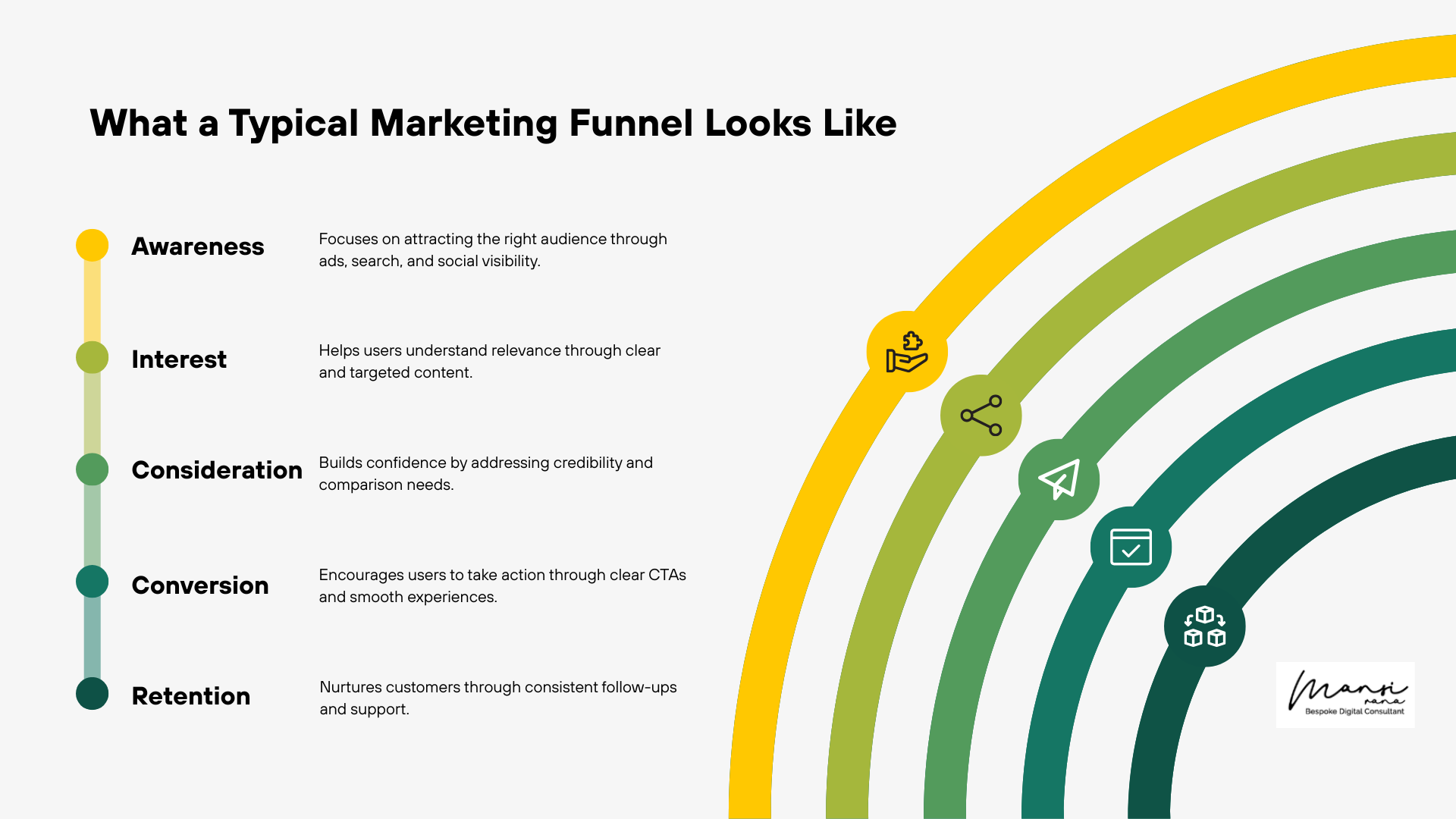
A standard marketing funnel follows some simple progression methods. This starts from Awareness → Interest → Consideration → Conversion → Retention. Each stage guides businesses on how to make the right approach so that the experience of customers remains smooth and relevant.
-
Awareness
The awareness stage introduces potential customers to a brand through proper ads, search results, or social media sites. Funnel leaks often occur when messaging attracts significant attention but fails to reach a relevant audience group.
-
Interest
At the interest stage, users engage with the right content to understand relevance. Leaks happen if information feels generic, unclear, or misaligned with user needs. These often cause early disengagement.
-
Consideration
During consideration, some prospects compare options and evaluate credibility. Sometimes, missing trust signals, weak value propositions, or even confusing page structures cause users to exit before taking any action.
-
Conversion
The conversion stage focuses on action, such as form submissions or purchases. Leaks also occur due to friction-heavy forms, unclear CTAs, slow pages, or in cases of uncertainty about next steps.
-
Retention
Retention involves nurturing customers through post-conversion, communication, and support. Leaks arise when follow-ups are inconsistent, delayed, or even irrelevant. These, as a result, reduce repeat engagement and long-term value.
Leaks can occur at any stage of this funnel. So, understanding the key insights and fixing even one stage can also significantly improve overall ROI. This, as a result, improves overall landing page clarity, reduces friction in forms, or speeds up overall response times. These all together also yield better results than increasing traffic volume. A funnel audit helps businesses to identify which stage needs refinement for better improvement.
Top Reasons Why Most Businesses Leak Leads
Even with strong traffic and active campaigns, many businesses face some struggles in converting visitors into significant leads. Almost 61% of marketers consider lead generation as their most significant challenge. The reason is rarely a single issue, but it is usually a combination of some small yet critical gaps across the funnel. From attracting the wrong audience group that fails to take part in follow-up, these leaks quietly drain the significant conversion potential. Below are some of the most common reasons businesses lose leads, and all those are clearly explained with some practical and real-world relevance.
Even with strong traffic and active campaigns, many businesses struggle to convert visitors into meaningful leads. Nearly 61% of marketers consider lead generation their biggest challenge. In most cases, the issue isn’t a single factor—it’s a combination of small yet critical gaps across the marketing funnel. This is where digital audit services play a key role by identifying what’s working, what’s not, and where leads are dropping off. From attracting the wrong audience to weak follow-up processes, these gaps quietly drain conversion potential. Below are some of the most common reasons businesses lose leads, explained with practical and real-world relevance.
-
Poor Traffic Quality
Not all traffic is considered valuable. When businesses focus on huge volume instead of intent, they often attract a huge number of visitors who are never likely to convert. Poor traffic quality creates high bounce rates, weak engagement, and wasted marketing spend. These make the whole thing one of the most damaging in the funnel leaks.
Poor traffic quality usually comes from wrong audience targeting and overly broad acquisition strategies. When businesses run ads using generic keywords or set a wide target to maximize reach, it brings a negative impact. While this increases genuine traffic numbers, it often brings users who do not have any real need or readiness to act. Social media traffic can further amplify this issue, as many users browse casually without any purchase intent.
When visitors arrive at a website without alignment between their intent and the offer, they leave the site quickly, sometimes within seconds. This leads to inflated bounce rates and low conversion metrics. Over time, teams find these problems because the issue lies behind an audience mismatch.
-
Weak or Confusing Landing Pages
Landing pages often create the stage for the first real interaction when a visitor visits your business. If the message is unclear or inconsistent with the source, users often lose interest too fast. Even high-intent traffic leaks if the landing page fails to guide visitors clearly on each step.
A weak landing page usually lacks a clear value proposition. When visitors visit a website, they want to understand what’s being offered and why things matter to them. When this clarity is missing, users often hesitate to move forward and leave. Another common issue is having too many CTAs competing for attention, or even none at all. This is a scenario that often leaves visitors confused about making the next step.
Slow page speed and even poor mobile experience further increase the chances of drop-offs, especially when most of the traffic comes from mobile devices. Message mismatch is another major leak. When an ad promises one perfect outcome, the landing page delivers something different, and trust breaks instantly. Users also feel misled and take a quick exit without engaging.
These problems don’t always show up during surface-level analytics, but they heavily impact genuine conversions. This is where a detailed funnel audit highlights where landing pages fail to support user intent and shows exactly where attention, clarity, and alignment need genuine improvement.
-
Forms That Kill Conversions
Forms kill the final barrier between interest and action. Even some motivated users abandon conversions when the forms feel very demanding, confusing, or risky. Poorly designed forms quietly waste all the effort spent to drive and engage traffic.
One of the biggest mistakes businesses often make is asking for too much information, and that is too early. Long forms with multiple mandatory fields create friction and also raise concerns about privacy and effort. Visitors also question why certain details are required, especially when the value behind that is not clearly explained.
Another common issue is the absence of trust signals near the forms. Without reassurance like privacy statements or credibility indicators, users often hesitate to share their personal information. Lack of clarity means they are left in doubt “what happens next,” and this also contributes to abandonment. When users don’t know whether they will receive a call, an email, or ongoing follow-ups, uncertainty often takes centre stage, leading to abandonment.
A significant number of users abandon certain carts due to unclear information, and these stats show that almost 20% cases happen due to unexpected costs, complicated checkouts, and lack of trust. These small doubts add up, causing users to exit at the most critical stage. A funnel audit evaluates length, field relevance, placement, and messaging to reduce the chances of friction and improve completion rates without increasing traffic.
-
Lack of Trust Signals
Trust is also very essential before any conversion happens. If visitors don’t feel confident about a business’s credibility, they will not prefer taking action, no matter how strong the offer is. Missing trust signals in such cases often create silent resistance that pushes the users.
Many businesses also underestimate how much validation users actually need before they feel confident to take some genuine actions. When landing pages lack some genuine testimonials, case studies, reviews, certifications, or clear business information, visitors often question the issues of legitimacy. This is especially applicable for first-time visitors who have no prior familiarity with a specific brand.
Trust signals act as strong proof and allow others to engage successfully and work safely with the business. Without them, users often hesitate to share their contact details or do not get the confidence to get involved financially. A missing business identity, like unclear company details, weak branding, or even absent contact information, further raises doubt.
A funnel audit in such cases helps to identify where credibility elements are missing or poorly positioned. When identified, these help to ensure trust signals at critical decision points, especially near CTAs and forms, where hesitations often take place.
-
Broken or Missing Tracking
When tracking is broken or incomplete, businesses often lose visibility. Decisions are also based on some assumptions instead of using proper data. These trigger the funnel leaks to remain unnoticed and unaddressed.
Without proper event tracking, businesses cannot accurately measure user behaviour. Missing or incorrect setups also result in some issues in CTA clicks, form submissions, and drop-offs. In many cases, leads are also generated but not attributed to the correct source, campaign, or page.
This lack of visibility often leads to poor decisions, and budgets also get increased for underperforming channels while high-performing ones are ignored. Optimization becomes guesswork rather than applying a superior strategy. Over time, businesses continue investing in certain areas that don’t convert, simply because they do not reveal the truth.
A funnel audit properly reviews the tracking architecture, guides on conversion events, and focuses on attribution logic. With accurate data, teams can also clearly see where users actually drop off and which changes can drive real improvement.
-
No Follow-Up or Slow Response
Lead generation doesn’t end with form submission. Slow responses or even missing follow-ups also cause high-intent leads to go cold quickly. This is one of the most costly leaks because the opportunity was already created, but never converted into reality. As per reports, only 20% of sales-qualified leads receive appropriate follow-up.
Many businesses also lose leads simply because they fail to respond in time. When leads are not contacted promptly, users often lose interest, and competitors also step in. Manual follow-ups also introduce delays, especially when teams rely on particular spreadsheets or shared inboxes.
The absence of email, CRM, or even WhatsApp automation also worsens the problem. Without immediate acknowledgment, users often feel ignored or undervalued. Even a delay of a few hours can significantly reduce the overall chances of better conversion.
A funnel audit also helps to evaluate the proper response times, identify automation gaps, and lead routing processes. By streamlining follow-ups and implementing some automated touchpoints, businesses can get the chance to recover lost opportunities, and these dramatically improve conversion rates, without increasing ad spend.
Key Metrics a Funnel Audit Should Analyse
A funnel audit relies on proper data to identify exactly where and why users disengage. These key metrics reveal the performance gaps and allow businesses to understand where traffic quality, genuine engagement, conversions, and revenue are being affected.
-
Traffic source vs conversion rate
When traffic source and conversion rate are compared, it shows lead quality across multiple channels, revealing the right sources that drive high-intent visitors and those that are generating volume without meaningful conversions.
-
Bounce rate & engagement time
Bounce rate and engagement time indicate whether visitors find proper, relevant content. It also shows early-stage friction caused by mismatched messaging, poor UX, or low content value.
-
CTA click-through rate
CTA click-through rate helps to measure how effectively calls-to-action capture significant attention and motivate users. These highlight certain issues with placement, messaging, or clarity. 70% of small business websites lack a clear CTA on their homepage, which often leads to abandonment by users.
-
Form submission rate
Form submission rate shows how many users complete forms after engaging. These help businesses to identify friction from form length, required fields, or lack of reassurance.
-
Drop-off points
The drop-off point shows the exact stages where users exit the funnel, helping them to focus on optimization instead of making assumption-driven changes.
-
Lead-to-sale ratio
The lead-to-sale ratio suggests lead quality and sales alignment. These, as a result, reveal whether marketing-generated leads convert into genuine yet actual revenue.
How to Identify Funnel Leaks (Audit Process)
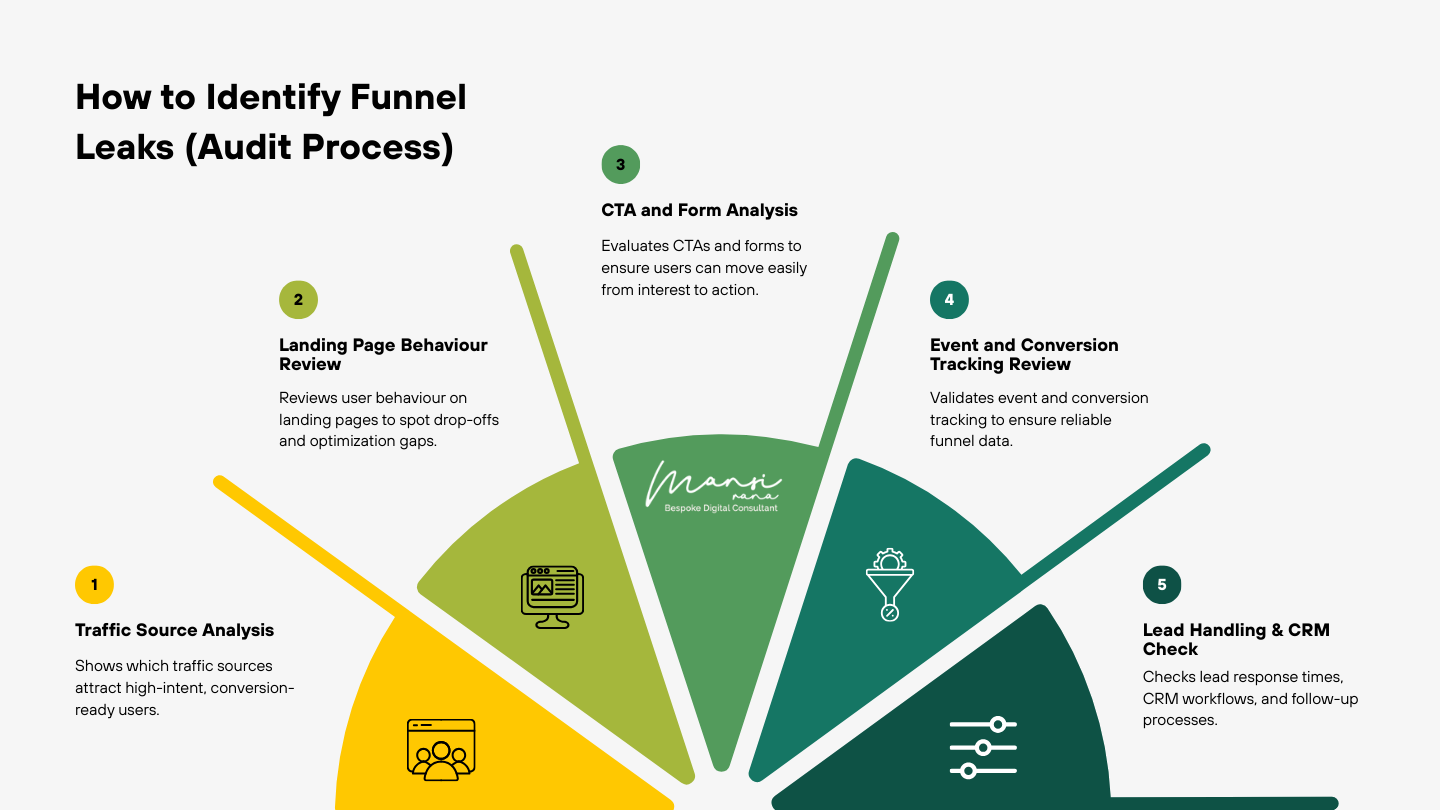
A proper funnel audit follows a proper, structured, step-by-step approach. This approach helps businesses to evaluate the entire customer journey, from their first interaction to post-conversion engagement, by analysing overall users’ behaviour, performance data, and certain system processes at multiple stages.
Thus, businesses can easily get the chance to identify exactly where some prospects drop off, why conversions fail, and which improvements are necessary to leave the highest impact. This approach also ensures that all decisions are made based on proper evidence, rather than opting for certain assumptions. Now, have a look at the step-by-step funnel audit approach to have a better insight:
1 – Traffic Source Analysis
Traffic source analysis helps to examine where the visitors actually originate and how each channel helps to bring genuine engagement and proper conversions. Organic search, paid ads, social media, and direct traffic are compared to identify some intent-driven and low-quality traffic. This step particularly helps to highlight whether the wrong audience target is being used.
Also, businesses can easily understand how even with untargeted campaigns, users are getting attracted, but unlikely to convert. Understanding this source-level performance helps businesses to refine their targeting strategies, and they can focus on genuine investment channels that bring some conversion-ready users.
2 – Landing Page Behaviour Review
Landing page behaviour reviews the proper evaluation of how users interact with the business through the landing pages after arriving. Metrics like bounce rate, scroll depth, session duration, and even mobile performance are analysed to understand genuine engagement patterns. High bounce rates also indicate unclear value propositions, slow load times, or even suggest poor content relevance.
Research shows that most landing pages experience bounce rates between 70% and 90%, leaving visitors to convert further. In such cases, landing page behaviour review helps to reveal whether the page effectively communicates the real value and guides users toward the next action.
3 – CTA and Form Analysis
CTA and form analysis guide users to understand how they can move from interest to action. The audit checks even the CTA visibility, messaging clarity, placement, and relevance to user intent. Forms are also reviewed for length, ease of completion, and to ensure overall user experience.
Drop-offs between CTA clicks and help in form submissions that often signal friction or hesitation. This step helps to identify certain opportunities to simplify multiple actions and remove frequent barriers that prevent users from completing genuine conversions.
4 – Event and Conversion Tracking Review
Accurate tracking is essential for identifying the proper funnel leaks. This step also helps to audit and guide key user actions, CTA clicks, form submissions, scroll depth, and genuine conversions, all of which are properly tracked. Missing or incorrect event tracking also hides real performance issues.
By validating the accurate tracking accuracy, businesses can also gain reliable insights into proper user behaviour, enabling data-backed decisions along with accurate funnel optimization.
5 – Lead Handling & CRM Check
Once a lead is captured, the audit helps to examine how quickly and effectively everything is handled. Response times, automation workflows, CRM integration, and lead assignment processes are also reviewed. Delays caused by manual follow-ups as well as unclear ownership often lead to significant lost opportunities.
This step ensures that the leads are acknowledged promptly, routed correctly, and also nurtured consistently. These, as a result, improve the chances of conversion. Nurtured leads make 47% larger purchases than non-nurtured leads.
6 – Post-Conversion Journey Review
The post-conversion journey review also helps to assess what happens after a user submits a form or converts users into leads. Confirmation messages and follow-up emails are also evaluated for better clarity and consistency.
Poor communication at this stage reduces trust and engagement, which is a matter for successful conversion. This step also ensures the funnel supports long-term relationship building, guiding genuine leads smoothly toward sales conversations and ensuring repeated engagement.
7 – Real Impact of Fixing Funnel Leaks
Fixing funnel leaks delivers some measurable business impact without increasing traffic or significant ad spend. By removing friction across the customer journey, businesses get the chance to convert more existing visitors, improve efficiency, and create a stronger foundation to ensure long-term growth. Such benefits extend beyond marketing metrics, positively influencing overall sales performance, revenue predictability, and scalability across certain channels and campaigns.
8 – Same Traffic, More Leads
When funnel leaks are fixed, the same volume of traffic starts generating more leads. Improvements in landing page clarity, CTA effectiveness, form usability, and follow-up processes ensure fewer visitors drop off unnecessarily.
Instead of chasing higher traffic numbers, businesses unlock hidden potential from existing users who already show interest. This leads to immediate gains in lead volume without additional acquisition costs, making growth more sustainable and less dependent on constant traffic expansion.
9 – Lower Cost Per Lead
Reducing funnel friction directly lowers the cost per lead. When more visitors convert from the same traffic sources, marketing spend becomes lower and brings effective results. Businesses no longer need to increase ad budgets because these help them to maintain lead volume.
Optimised funnels also reduce waste caused by poor targeting, weak pages, or slow responses. Over time, this efficiency allows the teams to reallocate budgets strategically and helps them to maintain or improve overall lead generation performance.
10 – Higher ROI From Ads and SEO
Fixing funnel leaks also amplifies genuine returns from every marketing channel. Ads and SEO efforts can also perform better when visitors encounter some clear messaging, strong trust signals, and smooth conversion paths.
Instead of losing users after the click, businesses can also get the chance to maximise the value of each visit. This improved conversion efficiency increases the chances of return on investment without raising the spend amount. As a result, both paid and organic channels deliver some stronger and more predictable performance over time.
11 – Better Sales Alignment
A well-optimised funnel successfully delivers higher-quality leads to the sales teams. Clear qualification, timely follow-ups, and even better intent alignment reduce the chances of friction between marketing and sales.
Sales teams that spend less time chasing unqualified leads get better at closing opportunities. Improved visibility also leads to better sources, and consumer behaviour also helps better sales conversations that start with better context. This alignment increases close rates, shortens sales cycles, and overall improves revenue efficiency.
12 – Scalable Growth
A leak-free funnel creates a scalable foundation for better growth. When systems, tracking, and processes are properly optimised, businesses can confidently focus on increasing traffic, launching new campaigns, or expanding their growth channels.
Growth becomes predictable rather than reactive. Instead of fixing certain issues after scaling, businesses can focus on other core parts. This allows better and sustainable expansion, better forecasting, and long-term performance improvements without involving the business in operational or conversion bottlenecks.
Funnel Audit vs Running More Ads: What’s Smarter?
When performance drops, many businesses focus on increasing ad spend, assuming more traffic will solve the problem. However, if the funnel itself is leaking, the chances are higher of additional traffic that only magnifies existing inefficiencies. More visitors who enter a broken funnel simply means more missed opportunities, higher bounce rates, and rising acquisition costs without proportional returns. Ad budgets even get exhausted faster, while the conversions remain stagnant.
Fixing these funnel issues first creates a far more sustainable impact. When the landing pages are clear, CTAs become more effective, forms become frictionless, and follow-ups are timely. In fact, every channel performs better: SEO, paid ads, social media, and referrals. Improvements at the funnel level also enhance conversion rates.
A funnel audit acts as a growth medium that helps to multiply growth. Instead of spending more to get the same results, businesses can extract greater value from the existing traffic. This approach also reduces waste, improves ROI, and builds a stronger foundation that supports better scaling without increasing unnecessary costs.
When Should a Business Do a Funnel Audit?
A funnel audit becomes very essential when performance signals often indicate inefficiencies or when a business prepares for genuine growth. These moments highlight all the hidden leaks and guide us on those that are often left unresolved. These can limit results and increase costs across marketing and sales efforts, ultimately weakening ROI, slowing momentum, and creating misalignment between teams and the strategies they plan to apply.
-
Leads Dropping Suddenly
A sudden decline in leads signals an underlying funnel issue rather than a serious traffic problem. Some significant changes in user behaviour, broken forms, tracking errors, or messaging misalignment can also silently disrupt conversions.
Without a funnel audit, the chances are higher for increased ad spend. Auditing the funnel helps to properly identify whether technical issues, UX changes, or even certain process gaps are causing the decline. This, as a result, helps to perform quick refinement.
-
High Traffic but Low Conversions
When traffic remains high, but conversions stay low, it usually indicates some prominent friction within the funnel. Visitors may be reaching the site but failing to understand the ultimate offer, or are not getting enough space to trust in completing actions. This mismatch often results in unclear value propositions, weak CTAs, or the arising of some form-related issues.
A funnel audit also pinpoints where users disengage, allowing businesses to improve conversion performance without chasing more traffic or expanding their budgets.
-
Rising Ad Costs
Increasing ad costs with declining returns are considered a strong indicator of funnel inefficiency. As platforms become more competitive, poor conversion rates often force businesses to spend more to achieve the same results.
A funnel audit identifies funnel leaks that inflate the cost per lead, like landing page friction or slow follow-ups. Fixing these issues improves efficiency, allowing businesses to reduce acquisition costs and stabilize them.
-
Low Lead Quality
Low-quality leads create tension between marketing and sales teams. When leads lack proper user intent, sales cycles affect the rate drop. This usually points to targeting some genuine issues, unclear messaging, or poor qualification within the funnel.
A funnel audit in such cases helps to align the right traffic sources, offers, and forms with ideal customer profiles. These, as a result, help to ensure that the generated leads are more relevant, engaged, and valuable for proper sales follow-up.
-
Scaling Plans for Next Quarter
Before scaling some marketing efforts, businesses have to ensure their funnel is well-optimised. Scaling a leaking funnel multiplies the chances of inefficiencies, increasing costs, and operational strain.
A funnel audit in such cases prepares the system for better growth and fixes the weak points in conversion and tracking. This ensures that increased traffic and spend often translate into measurable results, making growth more predictable and efficient.
How Often Should You Audit Your Funnel?
Regular funnel audits ensure your marketing and sales systems stay aligned with certain changes. These include changing user behaviour, multiple social media platforms, and business goals. Funnels are not constant, so even the small changes in traffic sources, technology, or audience expectations create leaks over time.
However, proper auditing at the right moments helps businesses to maintain better efficiency, allows them to protect ROI, and guides them to make confident scaling decisions without relying on assumptions.
1 – Quarterly for Growing Businesses
Growing businesses experience frequent shifts in traffic mix, customer intent, and internal processes. In such cases, quarterly funnel audits help to identify even the smallest issues before they compound into something serious. Regular reviews also help to reveal the declining conversion rates, emerging drop-off points, or even guide them on tracking gaps caused by certain changes.
This detail allows teams to optimise continuously without facing any disruption. By auditing every quarter, businesses can also maintain proper funnel health, improve forecasting accuracy, and ensure growth efforts remain efficient and measurable.
2 – Before Scaling Ads
Scaling accurate ad spend on an untested funnel magnifies inefficiencies and also increases wasted budget. Before increasing genuine investment, a funnel audit verifies that landing pages convert and forms function correctly. This, as a result, ensures additional traffic will produce proportional returns over time.
Auditing beforehand also prevents inflated cost per lead and often leads to poor ROI. It gives teams the necessary confidence that higher spend will drive growth, without exposing hidden weaknesses.
3 – After Major Website Changes
Major website changes often introduce some unintended friction into the funnel. Redesigns, content updates, new forms, or even proper CMS migrations can affect page speed, mobile usability, tracking, and conversion paths. Auditing immediately after certain changes helps to identify broken elements, message mismatches, or even lost events. This prevents prolonged lead loss that is often caused by unnoticed issues.
A post-change funnel audit also ensures new improvements, and it enhances significant performance rather than being involved in some disrupted conversions. These results also validate that certain updates support business objectives and help to maintain a consistent user experience.
4 – After Algorithm or Platform Changes
Algorithm updates and platform changes significantly impact traffic quality and user behaviour. Search engines, ad platforms, and even some proper social networks frequently adjust delivery, targeting, and certain visibility rules.
A funnel audit after these changes helps businesses to assess whether incoming traffic still matches intent and converts effectively. It identifies some new drop-offs that are caused by audience shifts or format changes. This proactive review ensures that businesses adapt quickly, protecting performance while realigning messaging, targeting, and funnel structure.
Common Funnel Audit Mistakes to Avoid
Common funnel audit mistakes prevent businesses from seeing real improvements, even after investing time and resources. These errors usually come from assumptions, rushed decisions, or overreliance on the surface-level metrics.
Avoiding these mistakes ensures audits uncover real issues. These often lead to some meaningful optimisation and deliver measurable results across marketing, sales, and long-term growth efforts.
1 – Focusing Only On Ads
Many businesses audit funnels by analysing the ad performance alone. This narrows down the focus to ignore landing pages, forms, tracking, and certain follow-up processes. Increasing ad spend without fixing certain funnel gaps also amplifies inefficiencies and wastes proper budget. 53% of marketers allocate about half of their budget to lead generation efforts.
However, a funnel audit should also evaluate the entire customer journey, not just some acquisition channels. When businesses fix significant conversion issues, every ad click becomes more valuable. This, as a result, improves results without continuously increasing spend.
2 – Ignoring Mobile Users
Ignoring mobile users is a common funnel audit mistake. These issues particularly occur when desktop metrics appear acceptable. Most traffic today comes from mobile devices, and poor mobile experiences cause silent drop-offs.
Slow load times, hard-to-read text, broken layouts, or even some difficult forms reduce conversions significantly. Auditing based on desktop behaviour hides these issues. So, remember that proper funnel audit reviews mobile speed, usability, and conversion flow separately. These audits ensure that the visitors receive the same clarity and trust.
3 – Not Testing CTAs
Not testing the CTA limits a funnel audit’s effectiveness. Many businesses also assume their calls-to-action are much clearer, but they affect the user behaviour. In such cases, CTA placement, wording, colour, and proper timing all influence clicks. Without testing variations, businesses often miss certain opportunities that improve engagement.
A funnel audit helps to analyse CTA click-through rates and test alternatives to identify what resonates. Small changes can significantly impact conversions, making CTA testing a critical step.
4 – Relying Only on Tools, Not User Behaviour
Relying only on proper analytics tools without understanding user behaviour often leads to incomplete funnel audits. Accurate numbers also show what happens, but not why it happens. Sometimes, session recordings and qualitative feedback also reveal confusion and shifts that data alone cannot explain.
When audits focus solely on dashboards, important context is missed. These combined behavioural insights with some quantitative metrics help businesses to identify real friction points, enabling more accurate fixes that align perfectly with how users actually think and act during real-world decision-making.
5 – Making Changes Without Data
Making changes without data is another damaging funnel audit mistake. Assumptions often lead businesses to fix the wrong problems, creating new friction instead of making genuine improvements. Without evidence, optimisations are based on mixed opinions rather than proper user behaviour.
A funnel audit that relies on metrics, tracking, and testing before implementing certain changes allows businesses to make data-driven decisions. These, as a result, reduce risk, prioritise high-impact fixes, and ensure improvements that can actually increase conversions. It does not disrupt performance or affect user experience unexpectedly across marketing, sales, and growth funnels, which ensures clarity and consistency in the long term.
Conclusion:
Funnel leaks happen not because businesses lack genuine effort, but because small and overlooked gaps lead to severe problems. Wrong traffic targeting, unclear landing pages, and even friction-heavy forms, broken tracking, and delayed follow-ups also quietly erode conversion potential. When decisions are driven by significant assumptions, these leaks remain hidden while costs continue to rise.
A funnel audit replaces significant guesswork with clarity. By analysing real user behaviour, data, and proper system performance, businesses can identify where prospects drop off and why. This allows some focused improvements that strengthen the entire funnel, rather than opting for some surface-level fixes that deliver some temporary relief.
The long-term impact also leads to higher conversion rates, better lead quality, stronger sales alignment, and sustainable growth. Instead of chasing more traffic, businesses that prioritise funnel audits and build systems can successfully convert. Growth also becomes more predictable and scalable when it is supported by a solid and well-optimised funnel rather than assumption or hope.
Looking to identify and fix hidden gaps in your marketing funnel? Connect with Mansi Rana Digital, a trusted digital marketing consultant in India, to get expert-led Digital Audit Services and a clear roadmap to improve conversions and growth.