The Conversation That Inspired This Blog
A founder of a 40-person edtech company called me last month. He had spent ₹18 lakh in nine months on three different “AI automation” vendors. The first built a chatbot that hallucinated course prices. The second wired up a Zapier flow that broke every time a lead form changed. The third disappeared after invoicing.
His question wasn’t “What is AI automation?” He knew. His real question was: “How do I tell a real consultant apart from someone who watched a YouTube tutorial last weekend?”
That conversation is the reason for this guide.
If you are searching for an AI automation consultant in India, you are likely past the curiosity phase. You want clarity on what they actually do, what it should cost, and whether the ROI is real. This is that guide — written from the perspective of someone who has spent 24+ years in the trenches of digital growth and has helped 16,000+ brands separate signal from noise.
No buzzwords. No 50-tool listicles. Just what works.
What Does an AI Automation Consultant Actually Do?
Strip away the jargon, and the role becomes simple. An AI automation consultant is the person who walks into your business, finds the workflows that are quietly bleeding your team’s hours and your P&L, and replaces those workflows with systems that combine AI models (like LLMs, vision models, or predictive ML) with automation platforms (like n8n, Make, Zapier, or custom Python pipelines).
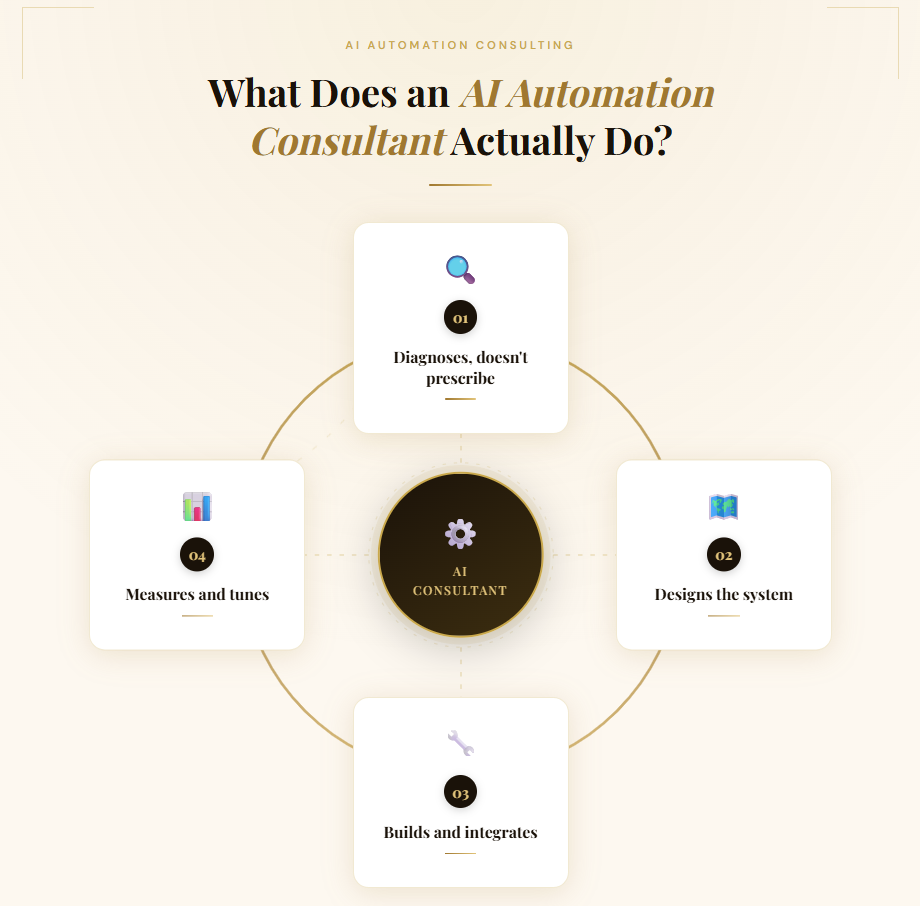
A good consultant does four things in this order:
- Diagnoses, doesn’t prescribe – Most engagements start with an audit — mapping out where humans are doing repetitive cognitive work that a machine can do better, faster, or cheaper. If a consultant pitches you a tool before they have studied your funnel, your CRM data, and your team’s daily rhythms, you are talking to a vendor, not a consultant.
- Designs the system – This is the architecture phase, which will be drafted for human approval and will remain fully human. What happens when the model is wrong? Where does the data live? Skipping this step is why so many AI projects break in month three.
- Builds and integrates – This is where automation platforms come in. The consultant connects your existing stack — CRM, email, support inbox, accounting software, ad accounts — and bakes AI into the seams.
- Measures and tunes – AI systems are not “set and forget.” Models drift. Customer behavior shifts. A serious consultant builds measurement into the system from day one and revisits it every quarter.
The difference between a freelancer and a consultant is this last step. Freelancers’ ship features. Consultants own outcomes.
Why India Is the Right Place to Hire One Right Now
This is not a patriotic flourish. It’s a market observation backed by data.
India’s AI consulting and automation industry is at a window when talent density is high, costs remain globally competitive, and government infrastructure is actively driving the ecosystem forward. Here are a few numbers worth knowing:
- The Indian AI market earned USD 22.8 billion in 2025 and is expected to reach USD 325 billion by 2033, with a CAGR of 38.1%. (Grand View Research, 2025).
- The IndiaAI Mission, which is supported by over USD 7 billion in government investment, is sponsoring AI computing, datasets, and skilling primarily for enterprise applications. (Future Market Insights,2025)
- India’s AI agents market was valued at USD 417 billion in 2025 and is expected to expand at a CAGR of 57.4% through 2033, one of the steepest growth curves in the world. (Grand View Research, 2025).
- Indian IT behemoths like Infosys have already implemented AI-powered automation across 1,800+ enterprise projects, cutting process turnaround times by up to 18%. (Business Research Insights, 2026).
Translation: the Indian consulting layer has real reps under its belt. The same engineers who built AI for Fortune 500s are now available to mid-market businesses, often through boutique firms.
But — and this is the catch — the market is also flooded with people who learned a tool last quarter and printed business cards. The talent floor is low, even though the ceiling is high. That makes choosing the right consultant the most important decision in the project.
The Services a Real AI Automation Consultant Offers
The deliverables vary by consultant, but the spectrum below covers what you should expect to see in a serious offer document.
Process automation and intelligent workflows – Replacing manual handoffs between tools — leads moving from ad to CRM to email sequence to sales rep — with end-to-end AI augmented pipelines. Public SME case studies show targeted automation can cut manual invoice processing time by up to 80%. (Distrya, 2026)
AI-powered customer support – Chatbots and voice agents that resolve tier-one queries without human intervention, while routing complex cases intelligently. Done well, an AI assistant handles roughly 80% of inbound queries. Done badly, it becomes the reason customers churn.
Sales and marketing automation – This is where the ROI is most legible. Sales teams that use AI agents achieve 25-47% productivity gains from time savings on repetitive tasks such as lead enrichment, intent scoring, and tailored marketing. (Vellum, 2025 On the marketing front, 76% of firms that incorporate AI agents into their stack achieve marketing automation success within a year. (Vellum, 2025
Content and creative pipelines – Brief-to-draft systems for blogs, landing pages, ad creatives, and social — with brand voice and SEO guardrails baked in. One agency case study saw a doubling of monthly article output (80 → 160 pieces) with no additional headcount. (Done For You, 2025)
Data and reporting copilots – Custom dashboards that don’t just show numbers but explain them in plain language, flag anomalies, and forecast next quarter. This is where mid-market companies finally get the analytics function they’ve always wanted but couldn’t justify hiring for.
Internal knowledge agents. Private AI assistants trained on your SOPs, contracts, and historical decisions — so a new hire on day three has access to what your senior team knows on day three thousand.
Industry-specific AI builds. For BFSI, healthcare, real estate, or edtech, this means compliance-aware automation: fraud detection in finance, patient triage in healthcare, lead qualification in real estate, and drop-off recovery in edtech.
The Real Benefits — Stated Without Inflation
I’ll skip the breathless “10x your business” claims and stick to what the data and our client work consistently show.
Time recovery. Most clients reclaim 5 to 15 hours per week per knowledge worker within the first three months. That is the single most consistent outcome across industries.
Cost compression where it matters. A frequently cited figure across 2024–2025 research is a
Businesses that invest significantly in AI automation should expect a 40% boost in operational efficiency and a 25% decrease in hiring costs. (ColorWhistle 2026)
Faster decision-making. Companies that use full automation report 30% faster decision-making cycles compared to human methods. (ResearchGate Study on Intelligent Automation ROI, 2025)
Forecasting accuracy. 84% of business leaders in EY’s survey said AI improved their forecasting accuracy. For SMEs operating on thin margins, this is often the difference between a profitable quarter and a panicked one.
Better data, finally. 74% of organizations in Deloitte’s research said AI accelerated their data analysis processes. The unsexy benefit of AI automation is that it forces clean data — and clean data is a competitive moat.
The benefit nobody talks about: team morale. When you remove the soul-crushing parts of a job — copy-pasting between tools, hunting for files, formatting reports — your good people stay longer and do better work. I’ve watched this play out in client teams again and again.
What It Should Realistically Cost in India
Pricing is the part most blog posts dodge. Here is the honest range I see in the market in 2026.
Audit and strategy engagement: ₹50,000 to ₹3 lakh, depending on company size and scope. A genuine consultant should be able to deliver a clear roadmap document at this stage — without it, do not move forward.
Pilot project (one workflow): ₹1.5 lakh to ₹6 lakh. This is the right way to start. Pick one process, automate it, and prove ROI in 30–60 days.
Full implementation engagements: ₹5 lakh to ₹40 lakh+ for mid-market businesses, depending on complexity, integrations, and whether custom models are involved.
Retainers for ongoing optimization: ₹40,000-₹2.5 lakh per month.
If someone quotes you a five-figure flat fee for “AI transformation,” they are either undercharging because they don’t know what they are signing up for, or they are selling you a template. Neither is what you want.
The Five Mistakes Founders Make
After years of doing audit calls with founders who hired the wrong consultant, the same patterns repeat:
- Buying tools before defining problems. “We need ChatGPT integrated” is not a brief. The brief is “Our sales team spends 12 hours a week qualifying leads we end up disqualifying — fix that.”
- Skipping the data audit. Industry research suggests 80% of failed AI projects fail because of bad data, not bad AI. (Distrya, 2026) If your customer records live in three spreadsheets and a WhatsApp group, organize first, automate second.
- Hiring the cheapest quote. Consulting is one of the categories where cheap is genuinely expensive. Rebuilding a broken automation costs more than building it right the first time.
- Trying to automate everything at once. Pilot one workflow, prove it works, expand. Boil the ocean, and you will burn budget and team trust simultaneously.
- No internal owner. Even the best external consultant cannot succeed if no one inside your company is accountable for adoption. This person doesn’t need to be technical — just responsible.
How to Choose the Right AI Automation Consultant in India
Forget the awards and the client logos for a moment. Here is what actually predicts whether an engagement will succeed.
They start with your funnel, not their tools. A consultant who can talk fluently about your customer journey before you mention AI is a consultant who will build something useful.
They show you broken systems, not just success stories. Anyone who has built real automations has watched some of them fail. If a consultant only has wins to share, they have not done enough work.
They quantify ROI before you sign. A serious proposal will state, in numbers, what you should expect to save or earn — and over what timeline. Vague promises are a tell.
They write the documentation. When the engagement ends, can your team operate the system? If the consultant is the only person who knows how it works, you have bought a dependency, not an asset.
They have a view on what not to automate. Maturity in this field is knowing where humans should stay in the loop — customer escalations, hiring decisions, sensitive content, anything legal. A consultant who wants to automate everything is a consultant who hasn’t been burned yet.
How to Start: A 30-Day Plan You Can Run Right Now.
If you take nothing else from this post, take this. You don’t need a six-figure budget to begin.
Days 1–7: List your time leaks. Have every team lead log, for one week, the tasks that feel repetitive and joyless. This is your automation candidate list.
Days 8–14: Score them. For each task, calculate: (hours spent per week) × (hourly cost of the person doing it). The biggest numbers are your starting points.
Days 15–21: Audit the data. For your top three candidates, check whether the underlying data is clean and accessible. If not, that is the first project, not the automation.
Days 22–30: Run a small pilot. Pick one workflow. Set a measurable goal (e.g., reduce lead response time from 4 hours to 15 minutes). Engage a consultant specifically for the pilot. If it works, expand. If it doesn’t, you’ve spent a fraction of what a full engagement would cost.
This is the playbook we run with our own clients — and the reason engagements that begin small almost always grow into long partnerships.
A Final Word, Founder to Founder
AI automation is not magic. It is not a substitute for a clear product, a sharp positioning, or a team that cares. What it is is the most powerful operational lever available to mid-market businesses in 2026 — if it is implemented by someone who understands your business as well as they understand the technology.
The companies that will pull ahead in the next 24 months are not the ones that adopt the most AI tools. They are the ones that adopt the right AI tools, in the right order, with a partner who is honest about what works and what doesn’t.
That is the kind of work we do. And if any of this resonated with what you are wrestling with right now, the next step is a real conversation — not a sales pitch.
Ready to Find Out What’s Actually Worth Automating in Your Business?
If you’ve read this far, you’re not looking for hype — you’re looking for a partner who will give you the unfiltered version.
Here’s what we offer founders and CMOs serious about scaling with AI:
A Free 30-Minute Strategy Session where we look at your current funnel, identify the three highest-ROI automation opportunities specific to your business, and tell you honestly whether you need a consultant at all — or whether your team can run the first pilot internally.
No proposals attached. No follow-up email sequences. Just a real conversation with someone who has helped 16,000+ brands grow.
Book Your Free Strategy Session
If you’d rather start with a deeper diagnostic, our AI Automation Audit gives you a written roadmap of where AI fits in your stack, what to automate first, and what to leave alone — usable whether you work with us or not.
Frequently Asked Questions
How long does it take to see ROI from AI automation?
For well-scoped pilot projects, most clients see measurable ROI within 30 to 60 days. Larger transformation programs typically show meaningful results in 4 to 6 months. Industry research notes that early adopters in 2025 report operational improvements within 6 months—significantly faster than the 12–18-month timelines reported in 2020–2022.
Is AI automation only for large enterprises?
No. In fact, mid-sized businesses often see faster ROI because their processes are less entrenched and easier to redesign. Cloud-based AI platforms have made enterprise-grade automation affordable on subscription pricing — the floor is now in the low five figures (INR), not the seven figures.
Will AI automation replace my team?
Done correctly, it does the opposite. AI automation handles the repetitive parts of jobs, freeing your team to focus on the work that actually requires human judgment. Companies that frame AI as augmentation rather than replacement consistently see better adoption and morale.
What industries benefit most from AI automation in India?
Currently, the strongest returns are in BFSI, e-commerce, edtech, healthcare, real estate, and manufacturing — all sectors where high-volume, repetitive workflows meet rich digital data. That said, almost any service business with a CRM and an email inbox has automation candidates.
How do I know if my business is ready for AI automation?
Three quick checks: (1) Do you have repetitive, rule-based tasks consuming team hours? (2) Is your data digitized and reasonably organized? (3) Is one person internally willing to own the implementation? If you can answer yes to all three, you’re ready to start with a pilot.
Mansi Rana is a boutique digital growth consultant with 24+ years of experience and the founder of EZ Rankings. She has helped 16,000+ brands across BFSI, education, healthcare, real estate, and luxury build predictable growth systems — and now advises founders and CMOs on AI automation, brand strategy, and digital audits.