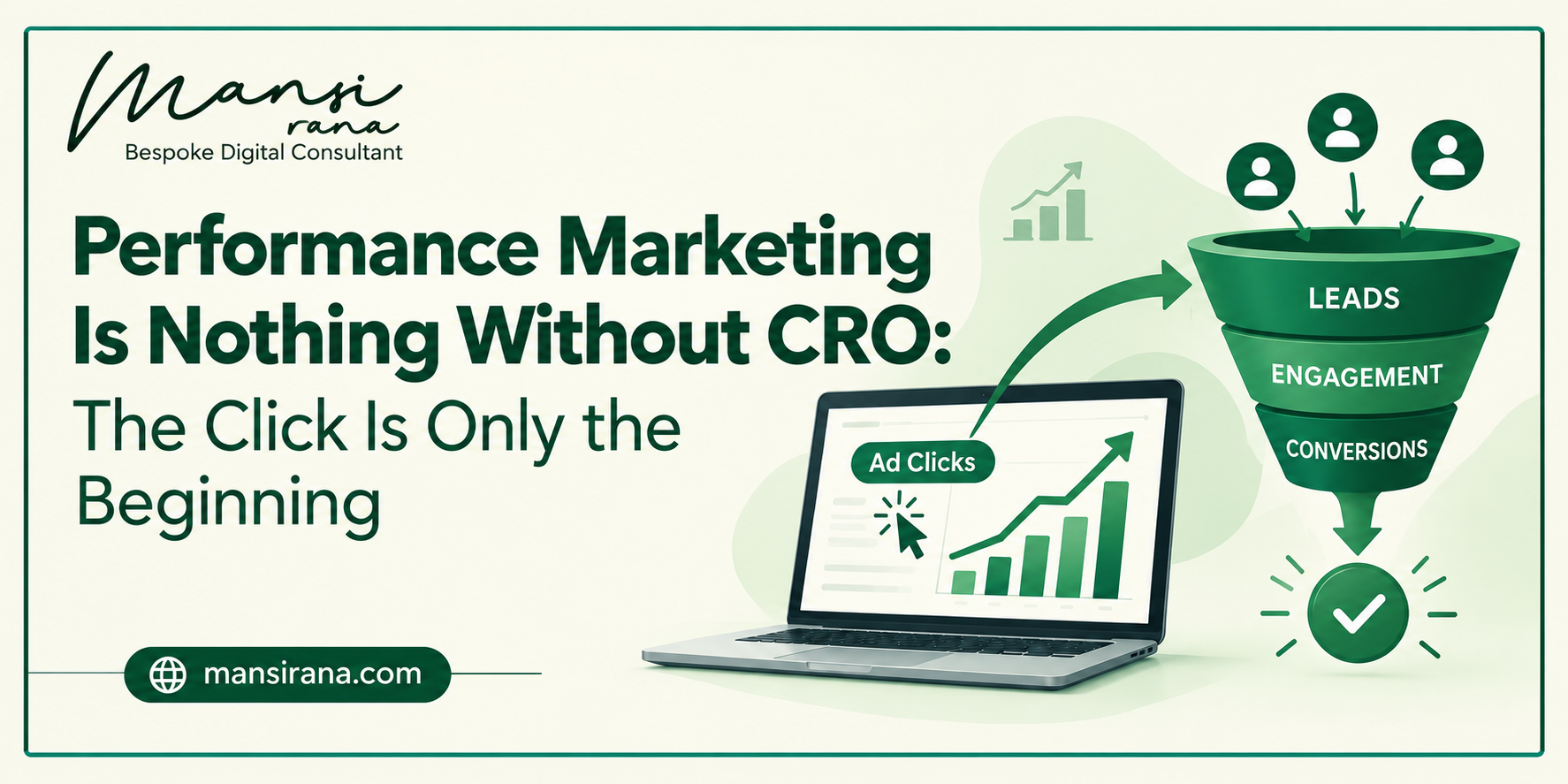
There’s a number every performance marketer loves to see go up.
CTR.
Another one they want to see come down.
CPC.
And then there’s the number everyone eventually cares about:
Revenue.
The problem is that these three numbers don’t always move together.
You can have a campaign with an impressive click-through rate, affordable traffic and thousands of visitors — and still wonder why sales aren’t moving.
That’s where Conversion Rate Optimization, or CRO, enters the picture.
And here’s the uncomfortable truth:
Performance marketing without CRO is often just an expensive way of sending more people into a broken funnel.
Performance marketing gets people to click.
CRO gives them a reason to continue.
One brings the visitor to your digital doorstep. The other helps turn that visitor into a customer.
They aren’t two separate marketing activities. They are two halves of the same growth equation.
The Click Is Not the Conversion
Imagine you run an ad saying:
“Get a Free Marketing Strategy in 30 Seconds.”
The ad looks great. The copy is sharp. The audience is well targeted. People are clicking.
Your CTR goes up.
Your marketing team celebrates.
Then users land on the page.
Instead of a simple form, they see 12 fields.
The headline doesn’t match the ad.
The page loads slowly.
There are three different CTAs.
And the user has no idea what happens after submitting the form.
What do you think happens?
They leave.
Now imagine the marketing team looking at the numbers and saying:
“Maybe the audience isn’t right.”
So they change the targeting.
Or perhaps they say:
“We need more traffic.”
So they increase the budget.
This is where things get expensive.
Because the problem wasn’t necessarily the audience.
The problem was what happened after the click.
A click is intent, but it isn’t commitment.
Someone clicking your ad is basically saying:
“This looks interesting. Tell me more.”
Your landing page then has to answer:
“Why should I trust you?”
“Is this actually relevant to me?”
“What do I get?”
“Why should I act now?”
That’s CRO.
Performance Marketing Creates the Promise. CRO Keeps It.
Think about the customer journey as a conversation.
Your ad starts the conversation.
Your landing page continues it.
Your offer makes the argument.
Your CTA asks for the action.
If those pieces don’t sound like they’re coming from the same conversation, the customer gets confused.
For example, your ad might say:
“Launch your website in 7 days.”
The user clicks.
But the landing page says:
“Welcome to our digital solutions ecosystem.”
That’s technically related.
But psychologically, there’s a disconnect.
The user didn’t click because they wanted an “ecosystem.”
They clicked because they wanted a website in seven days.
This is why message match is one of the most underrated parts of CRO.
The promise made in the ad should feel familiar when the visitor reaches the page.
The journey should feel natural.
Not like the customer has been dropped into a completely different conversation.
You Can’t Optimize Your Way Out of a Bad Landing Page
This is probably one of the biggest mistakes in performance marketing.
Teams spend hours optimizing campaigns:
- Changing audiences
- Testing ad creatives
- Adjusting bids
- Tweaking keywords
- Lowering CPC
- Improving CTR
- Expanding targeting
But sometimes the biggest growth opportunity isn’t inside the ad account.
It’s on the website.
If your landing page converts 1 out of every 100 visitors, sending another 10,000 people to it doesn’t magically solve the problem.
It simply gives the same problem more people to meet.
That’s why I like looking at performance marketing as a traffic engine and CRO as a leak-detection system.
Before you push harder on the accelerator, check whether the car has a hole in the fuel tank.
More Traffic Isn’t Always More Growth
Let’s make this simple.
Suppose you send 100,000 visitors to your website.
At a 1% conversion rate, you get:
1,000 conversions.
Now suppose you don’t increase your traffic at all.
Instead, you improve the experience and take the conversion rate to 3%.
Those same 100,000 visitors now generate:
3,000 conversions.
Same traffic.
Same audience.
Same ad spend.
Different outcome.
That’s the power of CRO.
It doesn’t always ask:
“How can we get more people?”
It asks:
“How can we get more value from the people we already have?”
And sometimes, that’s a much smarter growth question.
Cheap Traffic Can Be More Expensive
Here’s another performance marketing trap.
We often assume cheaper clicks are better.
They aren’t.
A ₹20 click isn’t necessarily better than a ₹60 click.
It depends on what happens after the click.
Imagine Campaign A brings visitors at ₹20 per click, but hardly anyone purchases.
Campaign B brings visitors at ₹60 per click, but those visitors have strong purchase intent and convert significantly better.
Which campaign would you rather have?
The answer isn’t hiding in CPC.
It’s hiding in customer acquisition cost and profitability.
That’s why performance marketing should ultimately move beyond metrics like impressions, CTR and CPC.
Those numbers tell you what’s happening at different stages of the funnel.
But the business cares about something bigger:
How much does it cost to acquire a customer, and how much value does that customer generate?
CRO can dramatically change that equation.
CRO Is Not Just Button Color
Let’s clear up one common misconception.
CRO isn’t simply:
“Let’s make the button green.”
Or:
“Let’s move the CTA higher.”
Or:
“Let’s change the headline.”
Those things can matter.
But real CRO goes much deeper.
It’s about understanding why people aren’t converting.
Maybe the offer isn’t clear.
Maybe the pricing creates uncertainty.
Maybe customers don’t trust the brand yet.
Maybe the form feels too demanding.
Maybe the page doesn’t answer the customer’s biggest objection.
Maybe the CTA comes too early.
Maybe the customer needs proof before making a decision.
Maybe the website is speaking about the company when it should be speaking about the customer.
These aren’t design problems alone.
They’re decision-making problems.
And CRO is essentially the process of removing unnecessary friction from that decision.
Your Website Is a Salesperson
Here’s a useful way to think about CRO.
Your website is working even when your marketing team isn’t.
At 2 p.m., it’s selling.
At midnight, it’s selling.
On a Sunday morning, it’s selling.
So ask yourself:
If my best salesperson were handling every visitor, would they communicate the same way my landing page does?
Would they immediately explain the value?
Would they answer objections?
Would they provide proof?
Would they make the next step obvious?
Would they ask for all the information before earning the customer’s trust?
Probably not.
A good salesperson doesn’t throw everything at you at once.
They understand where you are in the decision-making process.
Your website should do the same.
Performance Marketing Finds the Audience. CRO Learns From Them.
This is where the relationship becomes even more interesting.
Performance marketing isn’t only about bringing traffic.
It also gives you valuable information about customer behaviour.
Which search terms are people using?
Which ads are attracting attention?
Which audiences engage?
Where do visitors drop off?
Which pages get ignored?
Which offers generate action?
What objections appear repeatedly?
CRO takes these signals and turns them into insights.
So instead of guessing what customers want, you’re learning from actual behaviour.
Performance marketing tells you who is responding. CRO helps you understand why.
That feedback loop can make the entire marketing operation smarter.
Scaling a Broken Funnel Doesn’t Make It Better
One of the most dangerous words in performance marketing is:
Scale.
Because scale sounds like success.
But scaling isn’t automatically growth.
If your funnel has a serious conversion problem, scaling your campaigns simply exposes more people to that problem.
It’s like opening more taps while the drain is blocked.
You get more water.
You don’t necessarily get more results.
Before increasing ad spend, ask:
- Is the landing page converting?
- Is the offer clear?
- Is the traffic relevant?
- Does the page match the ad?
- Are there obvious trust issues?
- Where are users dropping off?
- Are we measuring the right conversion?
- What happens after the lead is generated?
Sometimes the smartest scaling strategy is actually to stop scaling for a moment.
Fix the leak.
Then accelerate.
The Real Battle Isn’t CTR. It’s CAC.
CTR is useful.
CPC is useful.
Conversion rate is useful.
But none of them exist in isolation.
A campaign can have a fantastic CTR and terrible economics.
Another can have an average CTR and excellent profitability.
The ultimate question is:
What does it cost us to acquire a customer?
That’s where CRO becomes commercially important.
If your media buying team can reduce acquisition costs by finding better traffic and your CRO team can improve the percentage of that traffic that converts, you aren’t choosing between performance marketing and CRO.
You’re creating a feedback loop where both make each other stronger.
Better traffic creates better conversion data.
Better conversion data creates better campaigns.
Better campaigns create more efficient traffic.
And the cycle continues.
Stop Treating CRO as the Final Step
CRO shouldn’t be something you remember after launching a campaign.
It should be part of the campaign from day one.
Before launching an ad, ask:
What happens when someone clicks?
Before increasing the budget, ask:
What happens to the next thousand visitors?
Before celebrating a lower CPC, ask:
Are these visitors actually valuable?
Before blaming the audience, ask:
Did we give them a good enough reason to convert?
These questions can completely change how you approach performance marketing.
Because growth isn’t simply about getting more people through the door.
It’s about making sure the experience inside is good enough for them to stay.
The Bottom Line
Performance marketing without CRO isn’t completely useless.
It can generate awareness, traffic, data and leads.
But without CRO, you’re leaving a huge part of your marketing performance to chance.
You can spend more.
You can target more.
You can create more ads.
You can generate more clicks.
But if the experience after the click doesn’t work, your marketing engine will keep running while your revenue quietly leaks away.
The smartest marketers don’t ask only:
“How do we get more traffic?”
They ask:
“What are we doing with the traffic we already have?”
Because the next breakthrough might not be another audience.
It might not be another ad.
It might not even require a bigger budget.
It could be one better headline.
One clearer offer.
One fewer form field.
One stronger proof point.
One smoother journey.
One less reason for the customer to hesitate.
Performance marketing gets you the opportunity. CRO helps you make the most of it.
And in a world where every click costs money, that’s not a small distinction.
That’s the difference between buying traffic and building growth.
Ready to Find What’s Leaking From Your Funnel?
If you’re already spending on Google, Meta, LinkedIn or other performance channels but feel your conversions aren’t keeping up with your traffic, don’t automatically increase the budget.
Start by finding the friction.
Audit your ads, landing pages, offers and conversion journey. Identify where potential customers are dropping off, understand why they’re hesitating, and turn those insights into experiments that can improve your numbers.
More traffic isn’t always the answer. Sometimes, you simply need to convert more of what you’ve already earned.
If you’re ready to turn clicks into customers, let’s talk CRO and performance growth with Mansi Rana, Digital Marketing Consultant in India.