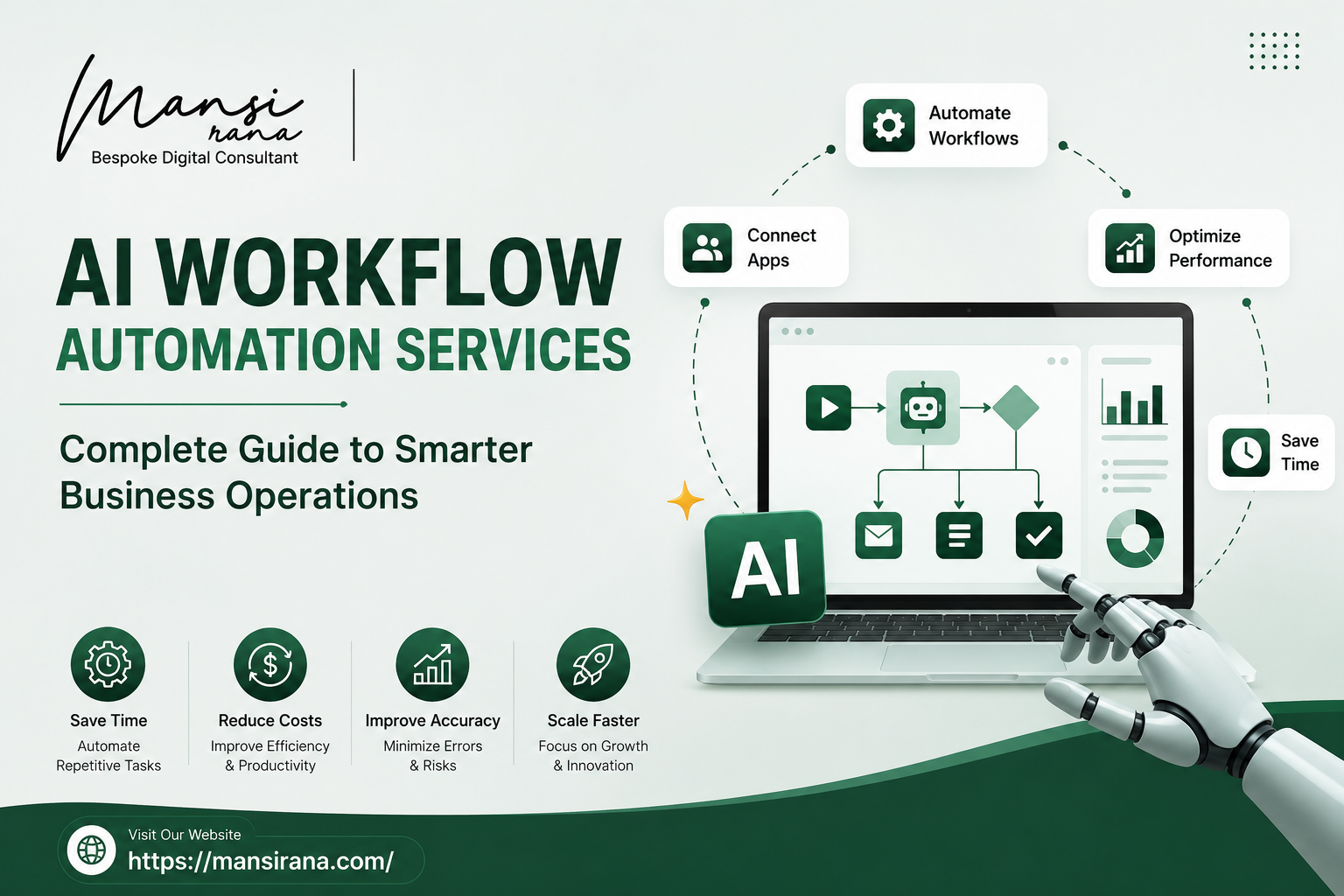
Smart people are stuck doing dull, repeatable work. Copying numbers from one screen into another. Waiting on an approval that has been sitting in someone’s inbox since Tuesday. None of it really needs a human, yet humans keep doing it anyway. That gap is what AI workflow automation services close.
It hands your repeatable processes to artificial intelligence so they run with little or no manual effort, and companies are catching on fast. The workflow automation market is expected to climb from roughly $26 billion in 2026 to nearly $41 billion by 2031. The real change here is not speed, though. It is intelligence. Old automation followed rigid rules. AI reads context, makes a call, and adapts while the work is still moving.
What Is AI Workflow Automation?
AI workflow automation is what happens when artificial intelligence runs your business processes for you, start to finish, without someone nudging every step along. Basic automation can only manage simple “if this, then that” rules. AI does a lot more than that. It understands context.
It reads messy things like emails and PDFs and supports tickets. It guesses what should happen next, and it sends work where it needs to go on its own. Picture a process that used to need a person at every turn. Now the system manages those handoffs by itself. It only pulls in a human for the cases that genuinely need one, and it gets a little smarter each time it runs.
How AI Workflow Automation Works
1. Data Collection
The system pulls data from wherever your business keeps it, your CRM, your email, your spreadsheets, your tickets, your invoices. Then it maps how things really move, not how the tidy flowchart on the wall says they should. What it is hunting for here are the repetitive, rule-based tasks. The ones people do the exact same way every single time. Sorting requests. Re-keying figures. Firing off the same status update for the hundredth time. Once those show up clearly, you can finally see where automation pays off.
2. AI Analysis
Then the AI digs into everything it gathered. It spots patterns most of us would never catch by hand, across thousands of past actions. Which requests stall out. Which sail through. Which ones quietly cause errors down the line. From all that, it starts predicting outcomes before they actually happen and picking the smarter path. This is also where routing gets smarter. Rather than dumping every item into one big queue, the system reads each task and sends it where it belongs based on what it contains and how urgent it is.
3. Workflow Automation
It is where things actually happen. Triggers do the heavy lifting. Some event occurs, a form gets submitted, a payment lands, a deadline hits, and the next step runs itself without anyone watching the clock. Approvals work the same way. A routine request that ticks all the right boxes gets approved on its own, and only the odd or risky ones land on a manager’s desk. Around all of that, the system fires off notifications and hands out tasks. It pings the right people, builds the to-dos, updates the records as it goes.
4. Continuous Optimization
Here is the part that separates AI from plain old automation. The system never really stops learning. It keeps an eye on how each workflow behaves, where things drag, where exceptions stack up, which routes turn out best, and then it tweaks itself. So the process gets better on its own. Routing sharpens. Predictions land closer to the mark. Those annoying bottlenecks that kept showing up start to fade.The workflow grows up alongside you, quietly rewriting its own logic month after month.
Also, Read – AI Automation Consultant in India: Services, Benefits
Top Benefits of AI Workflow Automation
Increased Productivity
The most obvious win is also the biggest one. Let machines take the repetitive grind and your people get their hours back for thinking, building, and looking after customers. Roughly 94% of workers say they do repetitive tasks that could be automated, and automation can hand back somewhere around 60 to 90 minutes of real work time per person, per day. Stretch that across a whole team and it adds up fast. A marketer who is not reformatting reports gets to plan actual campaigns.
Cost and Resource Savings
Manual work costs more than most leaders think, and the bill hides in odd places. Every hour of data entry. Every duplicated effort. Every mistake somebody has to circle back and fix. Automation chips away at all of it. Handling one invoice by hand can run close to $10. Let software do it and that often drops to about $2. And the savings are not only about cash. You get staff capacity back. You cut overtime. You stop hiring people just to survive the next busy stretch.
Faster Business Processes
The moment work stops parking itself in someone’s inbox, cycle times collapse. Approval flows tend to wrap up about 30% faster once automated. In insurance, a straightforward claim that once took days can now close in minutes. That speed is not a vanity metric. Slow processes lose you customers without you ever seeing it happen. AI kills the dead time between steps, so things move the second they are ready.
Improved Accuracy
People slip up when the work is boring and repetitive. We all do. And those small slips are a pain to catch and a pain to fix. A system does not get tired, does not zone out, does not turn sloppy at 5pm on a Friday. It runs the same logic every time, which knocks down errors in data entry, math, and routing. Fewer errors means less rework, fewer compliance scares, and a lot more trust in your own numbers.
Scalable Business Operations
Growth has a way of breaking the very systems that got you there. More customers, more requests, more approvals, more tickets. Hiring to keep pace is slow and expensive. This is where automation earns its keep, because software handles ten times the volume about as easily as it handles one. When a rush hits, your automated processes just soak it up. No scramble. No backlog building over the weekend. No drop in quality because everyone is drowning.
Superior Customer and Employee Experience
This one cuts both ways, which is what makes AI Workflow Automation Services worth considering. Customers get quicker replies, faster fixes, and the same steady service whether it is noon or midnight. A support ticket gets routed the instant it lands. An order update sends itself. People notice when things simply work, and that quietly builds loyalty. Your team feels it too. Strip out the draining, mind-numbing tasks and the work starts to mean something again.
Enhanced Decision-Making
Good calls need good information, and they need it at the right moment, not three weeks late. AI workflow automation keeps feeding leaders clean, current data instead of some stale report cobbled together by hand. It surfaces trends, flags trouble early, and shows what is genuinely going on across the business right now. Because the AI is always reading the patterns, it can suggest the next move and call an outcome before it fully forms. You guess less. You act on what is actually in front of you.
Also, Read – Digital Marketing Audit Framework: Strategy, Tools & Business Impact
Industries Using AI Workflow Automation
This is not a one-sector trick. In finance and banking, it speeds up loan approvals, fraud checks, and the compliance reporting nobody enjoys. Healthcare leans on it for patient intake, scheduling, and claims, which pulls clinicians out from under the paperwork. Retail and e-commerce automate order processing, stock updates, and frontline support.
Real estate teams use it to qualify leads and wrangle documents. Schools and edtech automate admissions and student messaging. Anywhere there is repetitive, rule-heavy work and a hunger for speed, automation tends to find its way in.
AI Workflow Automation Tools and Technologies
Popular AI Automation Platforms
Zapier is the usual first stop, wiring thousands of apps together so an action in one tool kicks off a step in another. Make.com plays in the same space but gives you a more visual, flexible canvas, which suits teams that like to fine-tune every branch.
For bigger operations, UiPath is the heavy hitter in robotic process automation, chewing through complex, high-volume work across enterprise systems. Microsoft Power Automate slots right into the Microsoft world, handling approvals, data syncing, and reporting across Office and beyond.
AI Models and Technologies
Machine learning lets a system learn from data and improve its own decisions without anyone reprogramming it. Natural Language Processing, or NLP, is what helps software read human language, so it can sort emails, summarize tickets, and pull the meaning out of a document.
Predictive analytics studies what happened before to forecast what comes next, like which lead is likely to convert or where a process tends to choke. Generative AI helps with drafting content, writing replies, and spinning up reports on demand. Stack these together and basic automation turns into something that understands, predicts, and creates.
CRM and Business Integrations
Automation really shines once it connects to the tools your team already lives in. Salesforce ties it into your full sales and customer pipeline, so follow-ups fire, records update, and leads route themselves. HubSpot does the same on the marketing and sales side, stitching campaigns, contacts, and deals into one smooth flow.
Slack ends up as the command center for alerts and approvals, letting people act on a task without ever leaving the chat window. Notion AI brings automation into the knowledge work, tidying notes, summarizing pages, keeping projects moving.
Why Businesses Should Invest in AI Workflow Automation Now
Massive Productivity Gains
McKinsey figures that generative AI and automation together could add somewhere between $2.6 and $4.4 trillion to the global economy every year. Behind that giant number is something simple playing out at scale, millions of hours of routine work sliding off people and onto systems.
For a company, the gain shows up quickly. Teams ship more without growing headcount. Output goes up while the stress goes down.
System-Level Efficiency
Automation is not just about speeding up one task here and there. It tightens the whole machine. Once your tools connect and the manual handoffs disappear, the friction between departments starts to melt. Something that used to sit in an inbox now lands exactly where it is needed, instantly. That kind of efficiency is tough for rivals to copy and easy for your team to feel. Projects move because nothing is waiting.
Cost Reduction
The savings stack up in ways you keep noticing. Companies pour staggering amounts into labor for work that could run itself. Inside a single business, that looks like overtime, rework, and people hired purely to keep up with volume. Automation flips a lot of that. You spend less on manual processing, you catch fewer expensive mistakes, and your current team suddenly goes further.
Data-Driven Agility
Markets do not wait around, and slow companies pay for it. AI Workflow Automation Services keep your data fresh and your read on things current, so you can react the moment something shifts. No more waiting on a month-end report to tell you what already happened. That is what real agility looks like. You catch a trend and move on it the same week. You spot a problem before it spreads anywhere. You change course on live signals instead of a hunch or a number that went stale two reports ago.
Competitive Advantage
This all comes back to one thing, staying ahead. The companies that automate run faster, cost less, and treat customers better than the ones still grinding through it by hand. With most organizations expected to have automation across their core processes within a few short years, the distance between the doers and the waiters keeps stretching. And waiting is not free. While you are still talking it over, someone else is already shipping faster and running leaner.
How to Choose the Right AI Workflow Automation Services
Start with the problem, not the shiny tool. The best AI workflow automation services ask what is actually holding you back. Look for a team that opens with a real audit of your current workflows and tells you straight where automation will pay off most, not where it will look most impressive in a demo.
Check that they know your world. A team that already understands your CRM and your compliance headaches will move quicker and skip the expensive mistakes. Ask how they handle the integration, the training, and the support after launch, because automation that nobody maintains slowly falls apart. And weigh honesty over the cheapest quote. You want a partner who walks you through their thinking, gives you realistic timelines, and measures the win by your results.
Future of AI Workflow Automation
The next chapter belongs to agentic AI. These are systems that do not just follow steps, they plan and run whole multi-step processes themselves. Instead of automating one task, an agent will take a job from end to end and only tap you on the shoulder when something genuinely needs a human call. Expect it to feel more conversational and a lot more proactive. Workflows will read context on the fly, anticipate what you need before you ask, and learn quicker with every run. Low-code and no-code tools will keep spreading, so non-technical teams can build their own automations.
Conclusion
Want to know exactly where automation would save your business the most time and money? Book a strategy session with Mansi Rana to explore AI workflow automation services, get an honest audit of your workflows, and walk away with a practical roadmap to smarter operations.
AI workflow automation is quietly becoming the baseline for how a well-run business operates. The story repeats across every industry. The companies that hand repetitive work to smart systems move faster, spend less, slip up less often, and free their people for the work that actually counts. To know more how it can help your company, book a strategy call with Mansi Rana – AI marketing automation agency today.