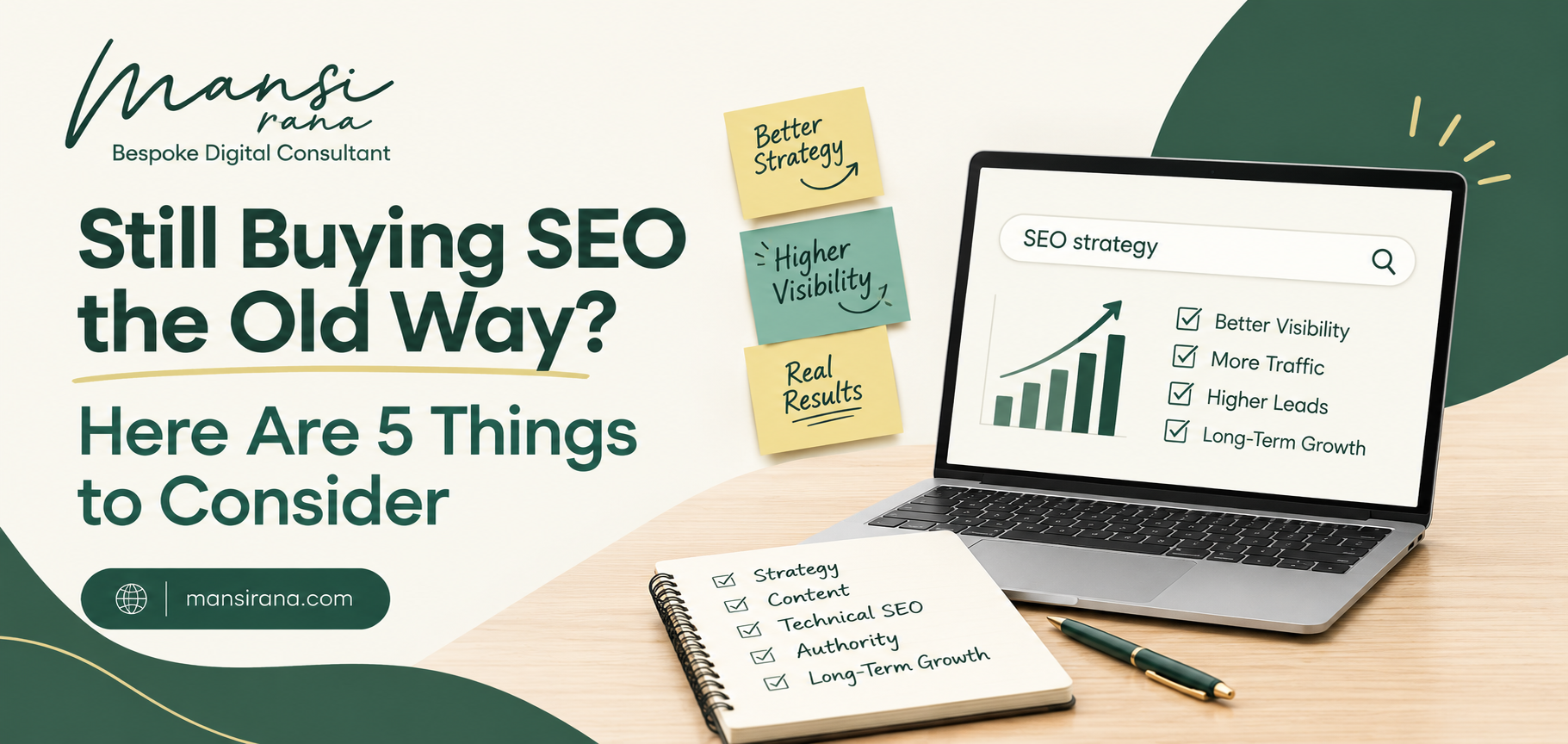
For years, buying SEO was relatively simple.
You hired an SEO agency. They gave you a list of keywords. Someone worked on your website, published a certain number of blogs, built backlinks, and sent you a monthly report showing rankings and traffic.
If a few keywords moved from page two to page one, everyone felt good.
But search has changed.
Today, people do not always search the same way they did five or ten years ago. They use Google, AI-powered search experiences, social platforms, YouTube, Reddit, maps, communities and increasingly conversational tools to find answers, compare options and make decisions.
Google now says its AI features, including AI Overviews and AI Mode, still rely on the same core Search systems and SEO fundamentals. At the same time, Google is placing increasing emphasis on useful, original, reliable, people-first content.
That means SEO is not dead.
But buying SEO the old way may be.
The bigger question businesses should ask today is not:
“How many keywords will you rank me for?”
It is:
“How will SEO help my business become more visible, trusted and profitable?”
Before you invest in SEO, consider these five things.
1. Stop Buying Rankings. Start Buying Business Outcomes
Rankings have turned into the product, which is one of the main issues with traditional SEO.
An organization would state:
“We will rank you for 50 keywords.”
It sounds amazing.
However, what happens if the traffic from those 50 keywords never results in a lead, inquiry, reservation, or sale?
Even with higher ranks, you could still receive unsatisfactory marketing outcomes.
The business is where modern SEO must start.
What do you truly hope to accomplish?
Perhaps you might like:
- More eligible leads
- Increased inquiries from prospective clients
- Increased sales online
- Increased awareness in a specific market
- Increased authority of the brand
- Reduced reliance on sponsored advertising
- More clients for particular goods or services
- Increased conversion rates from current organic traffic
Your SEO strategy should be influenced by these objectives.
For example, a B2B company may not need 100,000 monthly visitors. It may need 50 highly relevant visitors who understand the problem, trust the company and are ready to start a conversation.
Likewise, an e-commerce business may care less about ranking for broad informational keywords and more about appearing when someone is comparing products and is close to making a purchase.
So before signing an SEO contract, ask:
What business metric are we actually trying to improve?
Rankings and organic traffic are useful indicators. But they should support the bigger picture.
At Mansi Rana, the philosophy is increasingly about connecting SEO with the broader growth journey rather than treating it as an isolated activity. That means looking at SEO, content, funnels, paid media and conversion opportunities together.
That is a much healthier way to think about SEO investment.
2. Keywords Still Matter — But They Are No Longer the Whole Strategy
Keywords are not dead.
In fact, understanding what your audience searches for remains an important part of SEO.
The problem starts when keyword research becomes the entire strategy.
The old approach often looked like this:
Keyword → Write article → Add keyword several times → Build links → Wait for ranking
Modern search requires a much broader view.
Think about how a real customer behaves.
Someone searching for “best accounting software” may still be researching.
Someone searching for “accounting software for small business pricing” has moved further along.
Someone searching for “how to switch accounting software” may have a completely different intent.
And someone searching for a specific software brand may already know exactly what they want.
These are not simply different keywords.
They represent different stages of the buying journey.
Your SEO strategy should therefore understand search intent, not just search volume.
Ask:
- What problem is the customer trying to solve?
- What information do they need before making a decision?
- What objections might stop them from buying?
- What comparisons are they making?
- What questions do they ask before contacting a business?
- Which searches indicate strong commercial intent?
This also changes how you create content.
Instead of producing ten generic blogs because a keyword tool says there is search volume, you can build content around the real questions your audience needs answered.
Google’s own guidance makes this distinction clear. Its systems reward helpful, reliable, people-first content rather than content created primarily to manipulate rankings. Google also explicitly says there is no preferred word count you need to hit simply for SEO.
In other words, don’t ask:
“How many words do we need to rank?”
Ask:
“What does the reader need to know to make a better decision?”
That is a much stronger content strategy.
3. Your SEO Strategy Now Needs to Think Beyond Google’s Blue Links
This is perhaps the biggest change businesses need to understand.
Search is becoming more conversational and increasingly influenced by AI.
Google now has AI Overviews and AI Mode, and people also use AI tools to research products, companies, services, and questions.
This does not mean you need to throw away everything you know about SEO and start buying a mysterious new “AI SEO package.
In fact, Google says the opposite.
Its guidance states that existing SEO best practices remain relevant for AI features. Websites still need to be technically accessible, indexable and useful, while their content should provide genuine value.
What is changing is how visibility happens.
A customer might:
- Search for a broad question.
- Read an AI-generated summary.
- Visit several cited websites.
- Compare businesses.
- Search for reviews or opinions elsewhere.
- Visit your website later.
- Contact you after several interactions.
Your brand therefore needs to be useful across the entire discovery journey.
This is where concepts such as SEO, AEO (Answer Engine Optimization) and GEO (Generative Engine Optimization) are increasingly being discussed.
But don’t get distracted by terminology.
The underlying principle is simple:
Create information that search engines and AI systems can understand — and, more importantly, that people genuinely find useful.
That could mean:
- Clearly answering common customer questions
- Creating original research and insights
- Publishing expert opinions
- Demonstrating real experience
- Building useful comparison pages
- Improving internal linking
- Making important information easy to find
- Keeping business information accurate
- Adding relevant images, videos and structured information
- Building a recognizable brand
Google’s current guidance for generative AI search specifically emphasizes unique, valuable, non-commodity content and warns against producing large volumes of repetitive content simply to capture search demand.
So if an SEO provider is selling you “AI SEO” as a completely separate magic formula, ask them to explain exactly what they will change and why.
Good SEO should already be moving in this direction.
4. Content Quantity Is Not the Same as Content Quality
“Four blogs every month.”
“Eight blogs every month.”
“Twenty articles every month.”
These numbers can sound attractive when you’re buying SEO.
But ask yourself: Why do you need that many?
Publishing more content can be useful when every piece serves a clear purpose.
But publishing content to create more URLs is not a strategy.
Google’s current guidance specifically warns against producing lots of content across many topics simply in the hope that some of it will perform. It also warns against mass-produced content that does not provide meaningful value.
Imagine you have ten excellent articles that genuinely answer your customers’ biggest questions.
Would you rather have those ten pieces — updated, internally linked, promoted and connected to your products or services — or 100 generic articles that say almost the same thing as everyone else?
For most businesses, the first option is far more valuable.
Modern content should demonstrate something.
Experience.
Expertise.
Original thinking.
Evidence.
Useful information.
For example, instead of publishing another generic article called “10 Benefits of Digital Marketing,” a digital marketing consultancy could publish:
- Lessons from analyzing 100 website funnels
- Common SEO mistakes seen during website audits
- What actually happens when a business stops paid advertising
- A breakdown of why page-one traffic is not converting
- A practical framework for deciding between SEO and PPC
- A before-and-after analysis of a website improvement
These topics have something generic content often lacks: a point of view.
That is also where AI changes the content conversation.
AI can help with research, outlining, ideation and productivity. But using AI to mass-produce pages without adding expertise or value is not a sustainable SEO strategy. Google explicitly advises that AI-assisted content still needs to meet its quality and spam-policy requirements.
Use technology to work smarter.
Don’t use it as a substitute for knowledge.
5. Choose an SEO Partner Who Can Explain the “Why”
Perhaps the most important point is the simplest.
You should understand what you are paying for.
SEO can be technical. Crawling, indexing, canonicalization, redirects, schema, internal linking, Core Web Vitals, content clusters and search intent can quickly become overwhelming.
That does not mean your SEO provider should hide behind technical language.
A good partner should be able to explain:
- What is currently wrong?
- What are we prioritizing?
- Why does this matter?
- What will we change?
- What should we expect?
- How will we measure progress?
- What happens if something doesn’t work?
Be cautious of guarantees such as:
“We guarantee number-one rankings.”
Search is too complex and constantly changing for responsible SEO professionals to guarantee a particular ranking position.
Google itself notes that following SEO best practices does not guarantee that a page will be crawled, indexed or served in search results.
Instead, look for transparency.
Ask for a roadmap.
Ask what happens in the first 30, 60 and 90 days.
Ask how technical SEO, content, authority, conversion and reporting fit together.
And most importantly, ask whether the agency is willing to tell you what not to spend money on.
That last question can tell you a lot.
A trustworthy SEO partner shouldn’t just find more things to sell you. They should help you identify the activities that are most likely to create meaningful impact.
So, What Does Modern SEO Actually Look Like?
Modern SEO is less about chasing an algorithm and more about building a strong digital presence.
It combines technical health with useful content.
It combines search visibility with conversion.
It combines keywords with customer intent.
It combines Google Search with the broader way people discover information.
And it treats SEO as a long-term business asset rather than a monthly checklist.
A modern SEO program might include:
Technical SEO
Making sure search engines can crawl, understand and index your important pages.
Content strategy
Creating useful content based on real customer needs, questions and intent.
On-page SEO
Improving page structure, titles, headings, internal links and other elements that help users and search engines understand the page.
Authority building
Earning credible mentions, links, references and recognition rather than simply buying large quantities of questionable backlinks.
Conversion optimization
Ensuring organic visitors have a clear path to take the next step.
Measurement
Looking beyond rankings to understand traffic quality, enquiries, conversions and business impact.
AI-search readiness
Creating clear, useful and original information that can perform well as search experiences continue to evolve.
None of these elements exists in isolation.
That is why a good SEO strategy should be connected to the rest of your marketing.
Before You Invest in SEO, Ask These 5 Questions
If you’re currently considering an SEO agency, keep this checklist handy.
1. What business outcome are we trying to improve?
Don’t start with keywords. Start with the business.
2. Are we targeting search intent or simply search volume?
Fewer high-intent visitors can be more valuable than thousands of irrelevant visits.
3. Is our strategy designed for today’s search environment?
Your strategy should account for traditional search while understanding how AI-powered search experiences are changing discovery.
4. Are we creating genuinely useful content?
If your content looks like everything else online, producing more of it probably won’t solve the problem.
5. Can our SEO partner clearly explain what they are doing and why?
If you don’t understand the strategy, ask questions.
The right SEO partner should welcome them.
SEO Isn’t Dead. The Old Way of buying it is.
SEO still has enormous value.
Organic search can help businesses build visibility, credibility and a sustainable source of qualified traffic. But the definition of good SEO has expanded.
It is no longer enough to say:
“We got you rankings.”
The better conversation is:
“We helped more of the right people discover you, understand you, trust you and take the next step.”
That is the standard businesses should look for.
And if you are still buying SEO based only on keyword counts, monthly blog quotas and ranking screenshots, it may be time to rethink the investment.
At Mansi Rana – A Boutique Digital marketing Consulting, we focus on the bigger picture—from SEO and content to funnels, paid media, digital strategy, and measurable growth. The goal isn’t to chase every new marketing trend, but to understand what is changing, what still works, and where businesses should focus their time and money.
If you’re evaluating your current SEO strategy, start by learning.
Explore the latest digital marketing insights, SEO guidance and practical strategies on Mansi Rana Digital.
And when you’re ready to move from information to execution, get in touch to discuss what a modern, growth-focused SEO strategy could look like for your business.
Because the question isn’t whether you should invest in SEO.
The real question is whether you’re investing in the right SEO.