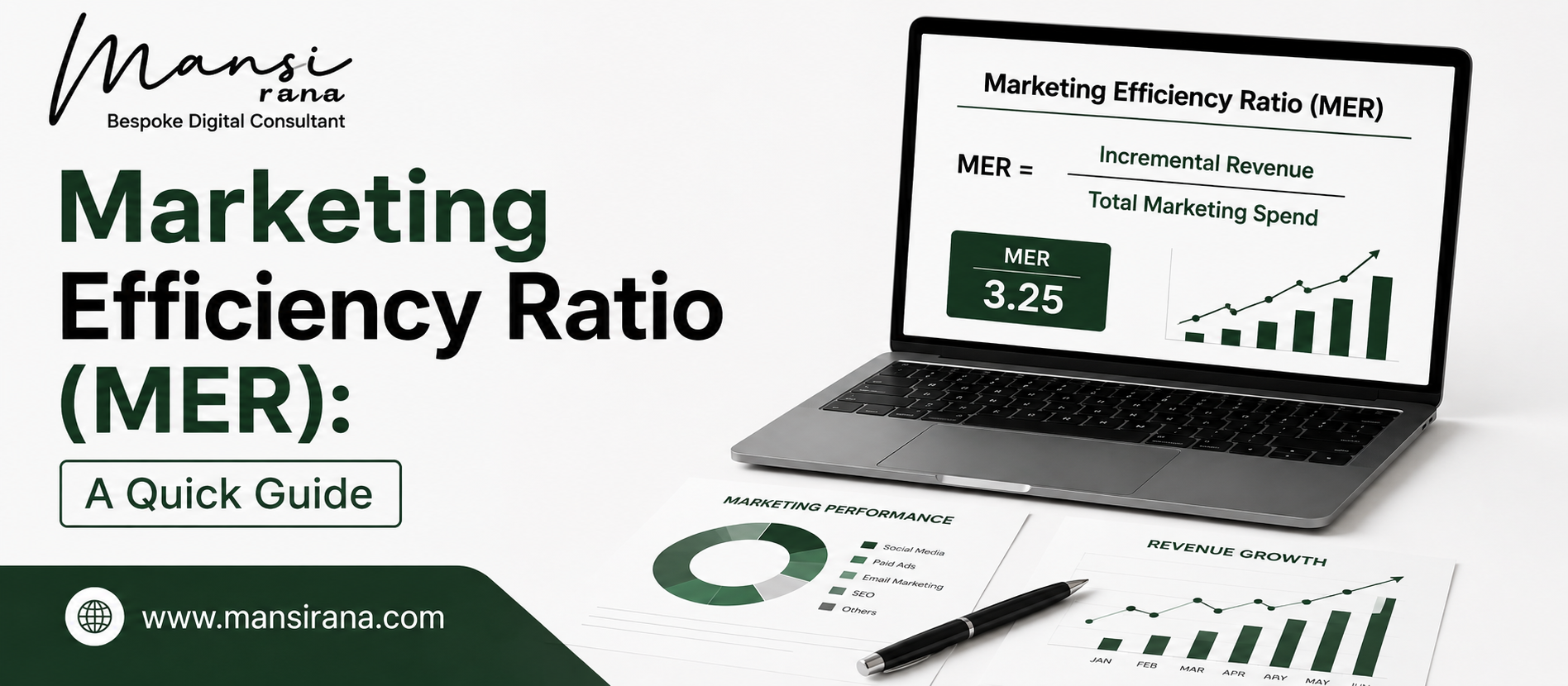
If you run a growing business, you probably have a long list of numbers to keep an eye on.
CAC. ROAS. Conversion rate. AOV. Repeat purchase rate. Revenue.
And then there’s MER.
It sounds like another marketing acronym that belongs on a dashboard somewhere. But MER is actually one of the simplest ways to answer a very important business question:
“For every rupee we put into marketing, how much revenue are we getting back?”
That is what makes MER (Marketing Efficiency Ratio) useful.
It doesn’t try to tell you which ad deserves credit. It doesn’t get caught up in whether Meta, Google, an influencer, an email or an organic search brought in a particular customer.
Instead, it steps back and looks at the bigger picture.
Let’s break it down.
What is MER?
MER stands for Marketing Efficiency Ratio.
The most commonly used formula is:
MER = Total Revenue ÷ Total Marketing Spend
So, if your business generates ₹50 lakh in revenue and spends ₹10 lakh on marketing:
MER = ₹50 lakh ÷ ₹10 lakh = 5x
That means your business generated ₹5 in revenue for every ₹1 spent on marketing.
Simple.
And that simplicity is actually the point.
Unlike metrics such as ROAS, which usually look at the performance reported by a particular advertising channel or campaign, MER gives you a blended view of your overall marketing performance.
Think of it as zooming out.
ROAS asks:
“How did this campaign perform?”
MER asks:
“How is our overall marketing investment performing?”
Both questions matter. They operate at different levels.
Also, Check – AI Workflow Automation Services – A Complete Guide
Why should you care about MER?
Because a business can look healthy inside individual advertising dashboards and still have a problem at the business level.
Imagine you are running Meta and Google campaigns.
Meta reports a 4.5x ROAS.
Google reports a 5x ROAS.
At first glance, everything looks great.
But then you look at the actual business numbers.
You spent ₹20 lakh across marketing and generated ₹60 lakh in total revenue.
Your blended MER is:
₹60 lakh ÷ ₹20 lakh = 3x
That number gives you a very different perspective.
This is where MER becomes useful.
It brings the conversation back to the relationship between what the business actually spends and what the business actually makes.
It also helps you avoid getting too excited about one platform’s numbers while ignoring what is happening across the whole business.
MER vs ROAS: What’s the difference?
This is probably the most common question.
The easiest way to think about it is:
ROAS looks in. MER (Marketing Efficiency Ratio) looks out.
ROAS — Return on Ad Spend — is generally used to understand the revenue attributed to a particular advertising campaign, channel or platform compared with its spend.
MER takes a broader view.
For example:
Metric What it tells you
Meta ROAS How Meta-reported revenue compares with Meta ad spend
Google ROAS How Google-reported revenue compares with Google ad spend
Campaign ROAS How a particular campaign is performing
MER How total revenue compares with total marketing spend
This doesn’t mean MER replaces ROAS.
You still need channel-level metrics to understand where to allocate and optimise your marketing budget.
But MER helps answer a bigger question:
“Are all these individual marketing efforts adding up to healthy business growth?”
That distinction is important because different platforms use their own attribution systems, and the same customer journey can involve multiple touchpoints. MER avoids assigning every sale to a single platform.
How do you calculate MER?
The formula is straightforward:
MER = Total Revenue ÷ Total Marketing Spend
Let’s take a simple example.
Say your business does ₹1 crore in revenue in a month.
During the same month, you spend:
- ₹8 lakh on Meta
- ₹5 lakh on Google
- ₹2 lakh on influencers
- ₹1 lakh on email and other marketing activities
Your total marketing spend is ₹16 lakh.
So:
MER = ₹1 crore ÷ ₹16 lakh
MER = 6.25x
In other words, for every ₹1 spent on marketing, the business generated ₹6.25 in revenue.
That’s your blended MER for the period.
The important word here is the same period.
If you’re comparing revenue from one month with marketing spend from another, the number won’t tell you much.
Keep the measurement window consistent.
What should you include in marketing spend?
This is where things can get a little messy.
There isn’t one universal definition of what every business should include.
The important thing is to define your formula clearly and use it consistently.
For a broader marketing MER, you might include:
- Paid advertising
- Influencer or creator fees
- Agency fees
- Affiliate commissions
- Email and SMS marketing costs
- Marketing software and tools
- Sponsorships
- Other direct marketing expenses
Some businesses calculate a narrower version using only paid media spend.
Neither approach is automatically “wrong”.
The problem comes when you change the definition every month because you want the number to look better.
If you want MER to be useful, consistency matters more than making the number look impressive.
Write down exactly what you’re including.
Then use the same definition every time.
What does a good MER look like?
This is where you need to be careful.
There is no universal MER number that every business should chase.
A 5x MER might be fantastic for one business and disappointing for another.
Why?
Because revenue isn’t profit.
Imagine two businesses both have a 4x MER.
Business A has a very healthy contribution margin.
Business B has thin margins, high shipping costs, heavy discounts and significant operating expenses.
Their 4x MER may look identical on a dashboard, but their economics could be completely different.
That’s why your MER needs to be viewed alongside:
- Gross margin
- Contribution margin
- CAC
- Average order value
- Repeat purchase rate
- Customer lifetime value
- Discounts and returns
- Operating expenses
The better question isn’t:
“Is 4x MER (Marketing Efficiency Ratio) good?”
It’s:
“Is our MER good enough for our business model and margins?”
That is a much more useful question.
MER and profitability
This is perhaps the most important thing to understand.
MER (Marketing Efficiency Ratio) is not the same thing as profitability.
A business can have a strong MER and still lose money.
Let’s say you generate ₹100 in revenue.
Your marketing cost is ₹25.
That’s 4x MER.
Sounds good.
But now imagine your product, shipping, payment fees, returns, discounts, salaries, rent and other costs add up to ₹90.
You haven’t made ₹75 in profit just because your MER is 4x.
MER only tells you how revenue relates to marketing spend.
It does not tell you what happens after that.
That’s why MER should be treated as an efficiency metric, not a standalone profit metric.
MER becomes especially useful when you’re scaling
Here’s where things get interesting.
Suppose your business currently looks like this:
₹10 lakh marketing spend → ₹50 lakh revenue
MER = 5x
You decide to double your marketing budget.
Now:
₹20 lakh marketing spend → ₹80 lakh revenue
Your revenue increased, which sounds great.
But your MER has fallen:
₹80 lakh ÷ ₹20 lakh = 4x
Should you stop spending?
Not necessarily.
This is where business judgement comes in.
You may have deliberately accepted a lower MER because you’re entering new audiences, launching new products, building brand awareness or trying to grow faster.
A falling MER isn’t automatically a disaster.
But it is a signal.
It tells you:
“We’re spending more to generate each additional rupee of revenue.”
Now you can investigate why.
Are your ads getting more expensive?
Are you reaching less qualified audiences?
Are your best-performing campaigns saturated?
Is your conversion rate falling?
Are customers buying less?
Has your average order value dropped?
Is repeat purchase revenue changing?
MER doesn’t necessarily give you the answer.
It tells you where to look.
What happens when MER improves?
The opposite is also useful.
Suppose you spend ₹20 lakh and generate ₹80 lakh.
That’s 4x MER.
A few months later, you spend ₹20 lakh and generate ₹1 crore.
Your MER is now 5x.
Something has improved.
Maybe your creative is better.
Maybe your website converts better.
Maybe your average order value has increased.
Maybe your organic traffic has grown.
Repeat customers may be contributing more revenue.
Your marketing mix may have become more efficient.
The point is that MER lets you see the combined effect.
It doesn’t tell you which of these things caused the improvement on its own.
That’s where your other metrics and your actual business context come in.
How often should you measure MER (Marketing Efficiency Ratio) ?
There isn’t one perfect answer.
For most businesses, weekly tracking and monthly analysis can work well.
Weekly numbers help you spot sudden changes.
Monthly numbers usually give you a cleaner picture because individual days can be noisy.
For example, a weekend sale, festival promotion or product launch can dramatically change your numbers for a few days.
Don’t panic because your MER moved from 4x to 3x for one day.
Look for trends.
Ask:
Is MER (Marketing Efficiency Ratio) improving, declining or staying relatively stable over time?
That trend is often more useful than one isolated number.
How to actually use MER in your business
Don’t put MER on a dashboard and never look at it again.
Use it to start conversations.
1. Use it when planning budgets
If your historical MER is 4x and you plan to spend ₹25 lakh, you can use that as a starting point for revenue planning.
At 4x:
₹25 lakh × 4 = ₹1 crore
That’s not a guarantee.
It’s a planning assumption.
And if you’re increasing spend significantly, expect efficiency to change.
2. Use it to spot efficiency problems
If revenue is growing but marketing spend is growing much faster, MER may start falling.
That deserves attention.
You don’t necessarily need to cut spending immediately.
First, understand what changed.
3. Use it alongside CAC
MER tells you about overall revenue efficiency.
CAC tells you how much you’re spending to acquire customers.
Together, they tell a much richer story.
For example:
MER is falling + CAC is rising
That’s a stronger warning sign than either metric alone.
On the other hand:
MER is stable + CAC is stable + revenue is growing
That can be a much healthier growth picture.
4. Use it when evaluating growth
Growth isn’t just about generating more revenue.
It’s about understanding what it costs to generate that revenue.
₹1 crore revenue with ₹10 lakh marketing spend and ₹1 crore revenue with ₹30 lakh marketing spend are two very different situations.
MER (Marketing Efficiency Ratio) helps make that difference visible.
Common MER mistakes
Mistake 1: Comparing yourself to someone else’s MER
A D2C brand selling high-margin products and a low-margin business with heavy fulfilment costs shouldn’t necessarily have the same MER target.
Your economics matter.
Mistake 2: Looking at MER without margins
A high MER doesn’t automatically mean high profit.
Always connect the number back to your contribution margin and overall unit economics.
Mistake 3: Changing the formula
If you include agency fees one month and exclude them the next, your MER isn’t really comparable.
Define it once.
Stick to it.
Mistake 4: Obsessing over one week’s number
Marketing performance moves around.
Look for trends rather than reacting to every small fluctuation.
Mistake 5: Using MER alone
MER is powerful because it is simple.
But simplicity can also hide detail.
Use MER with CAC, ROAS, conversion rate, AOV, retention and contribution margin to understand what’s really happening.
The simplest way to think about MER
Forget the acronym for a moment.
Imagine you are sitting with your finance team at the end of the month.
They tell you:
“We spent ₹10 lakh on marketing and the business generated ₹50 lakh in revenue.”
You immediately understand the relationship.
That’s MER.
5x.
The value of MER isn’t that it is complicated.
It’s that it gives you a simple business-level number that helps you step away from individual campaigns and ask a bigger question:
“Is our marketing investment helping us grow efficiently?”
And that is the question that ultimately matters.
Final thought
Knowing your MER (Marketing Efficiency Ratio) is one thing. Knowing what’s driving it — and whether it is healthy for your business — is another.
If you’re looking at your marketing metrics and wondering whether you’re spending enough, spending too much, or simply spending in the wrong places, let’s talk.
Get in touch with Mansirana and work with a growth strategy consultant to take a closer look at your marketing efficiency, customer acquisition costs, ROAS, and overall growth numbers.
Because better marketing decisions start with better questions — and a smarter growth strategy.