Key takeaways
-
Digital marketing outsourcing is increasingly driven by the need for specialized skills rather than purely cost savings, with 42% of businesses highlighting access to talent as a key benefit.
-
The financial landscape for marketing is challenging, with budgets stagnant at 7.8% of revenue, pushing more businesses to seek external expertise to meet high expectations.
-
Effective digital marketing outsourcing requires a clear understanding of goals and KPIs, a thorough audit, and a well-defined contract to ensure accountability and performance measurement.
-
Choosing the right model—whether a full-service agency, specialist, or consultant—depends on the specific needs of the business and the capabilities required.
-
Outsourcing allows businesses to access expert knowledge and resources quickly, enabling them to adapt to changing market demands without the overhead of building an in-house team.
Digital marketing is where most businesses now compete for attention, leads and loyalty. It is also harder to run well than it has ever been. Channels multiply, ad platforms change their rules, and AI is rewriting how search, content and campaigns work, sometimes within a single quarter.
The budget picture makes it tougher. Gartner’s 2026 CMO Spend Survey found that marketing budgets have stayed almost flat at 7.8% of company revenue, and 56% of CMOs say they lack the budget to deliver their 2026 strategy. Teams are being asked to do more, with new tools, without more money.
That is why so many businesses now outsource digital marketing. According to Market.us, the digital marketing outsourcing market is projected to grow from $25.4 billion in 2024 to $74.76 billion by 2034, an 11.4% CAGR. And the reason is shifting. As compiled by Prialto, only 34% of businesses now name cost as the main driver of outsourcing, down from 70% in 2020, while 42% cite access to specialised talent.
This guide explains what digital marketing outsourcing is, how it works, what it costs in India, how to choose a partner, and how to avoid the common mistakes.
Key Takeaways
- Outsourcing digital marketing means hiring an external agency, consultant or fractional leader to plan and run some or all of your online marketing.
- In 2027 the main reason to outsource is capability (specialists, AI-ready workflows, current tools), not just lower cost.
- Agency retainers in India typically range from about Rs 25,000 to Rs 5,00,000+ per month, plus ad spend and 18% GST.
- Judgment and execution are different problems. Work out which one you have before you pick a model.
- Protect yourself with clear KPIs, ownership of your accounts and data, and a contract that reflects India’s new data protection rules.
What Is Digital Marketing Outsourcing?
Digital marketing outsourcing is when a business hands responsibility for some or all of its online marketing to an outside partner. That partner might be a full-service agency, a specialist firm, a freelancer, a consultant or a fractional CMO. You get a skilled team without recruiting, training and managing one yourself.
The services you can outsource typically include:
- Search engine optimization (SEO), now increasingly covering AI search visibility
- Pay-per-click (PPC) and paid social advertising
- Content marketing
- Social media management
- Email marketing and marketing automation
- Analytics, reporting and conversion rate optimization (CRO)
The aim is the same as it always was: more qualified traffic, more leads and better returns from every channel. What has changed is the standard. A good partner is expected to bring AI-ready workflows, clean measurement and a point of view on where search is heading, not just a monthly report.
Common Outsourcing Models
Before choosing a partner, it helps to know what shape of help you are buying.
| Model |
Best for |
What you get |
Watch out for |
| Full-service agency |
Brands that need volume and multi-channel execution |
A team across SEO, paid, content, and creative |
Layers of account management between you and the strategist |
| Specialist agency or freelancer |
A single channel such as SEO or PPC |
Deep skill in one area |
Gaps between channels, with no one owning the full funnel |
| Consultant or fractional CMO |
Businesses with a judgment gap, not an execution gap |
Senior strategy, scorecards, and decision support |
Little or no hands-on production |
| Hybrid (consultant plus agency) |
Growth-stage brands scaling spend |
Strategy first, with execution scoped against it |
Needs a single owner for the scorecard |
Not sure which one fits? Our breakdown of whether to hire a fractional CMO or an agency gives you simple tests to find out. For a wider view of how the pieces fit together, see how outsourcing, consulting and audits work together.
How Does Outsourcing Digital Marketing Work?
A well-run engagement follows a predictable path. Skipping steps is where most outsourcing relationships go wrong.
1. Define Your Goals and KPIs
Start with outcomes, not channels. Do you need more brand awareness, qualified leads, lower acquisition costs or better pipeline quality? Turn each goal into a number you can track. Common KPIs include organic traffic, conversion rate, cost per lead, customer acquisition cost, return on ad spend and revenue influenced. Our guide to the KPIs that actually matter and this explainer on Marketing Efficiency Ratio (MER) will help you pick a short, honest scorecard.
2. Audit Where You Stand
Before handing anything over, understand your starting point. A digital marketing audit shows which channels are earning their keep, where tracking is broken and where leads are leaking. It also gives a new partner a baseline to be measured against. If you want the method behind it, read our digital marketing audit framework.
3. Shortlist and Vet Partners
Look at portfolios, case studies with real numbers, client references and industry fit. Ask who will actually work on your account and how senior they are. We cover the full checklist further down.
4. Scope the Work and Sign a Clear Contract
Agree on deliverables, reporting, timelines and exit terms in writing. Make sure you own your ad accounts, analytics properties, content and data from day one. A short initial term, such as three months with a review, lowers the risk of a first engagement.
5. Onboard Properly
Give your partner brand guidelines, target audience insights, past campaign data and access to the tools they need. Shared workspaces such as Asana or Trello for tasks, Slack or Zoom for communication, Google Drive for files and a live reporting dashboard keep everyone aligned.
6. Run, Report and Optimise
Set a rhythm: weekly check-ins on execution, a monthly performance review and a quarterly strategy reset. Expect early movement on paid campaigns within 30 to 60 days and SEO results over 90 to 120 days, based on our own client benchmarks. If clicks are arriving but revenue is not, look at the landing experience before adding budget. Our posts on performance marketing and CRO and funnel audits explain why.
Why Outsource Digital Marketing?
Building a complete in-house team is slow and expensive. You need strategists, SEO and paid media specialists, content creators, analysts and automation expertise, plus the tools to support them. The numbers below show why more businesses are choosing a partner instead.
Capability Now Matters More Than Cost
The old pitch for outsourcing was savings. The data now tells a different story. In Prialto’s outsourcing statistics roundup, cost was the primary driver for 34% of businesses in 2024 (down from 70% in 2020), while 42% said improved access to talent was a main benefit. The same roundup reports that 74% of employers across industries struggle to find the skilled people they need. Specialist marketers are a hard hire, and a partner with a bench of them is a shortcut.
Budgets Are Flat but Expectations Are Not
Gartner’s 2026 survey shows budgets stuck near 7.8% of revenue, with CMOs now putting an average of 15.3% of that budget into AI initiatives. Only 30% say their organisation has mature AI readiness. In other words, most teams are being told to deliver AI-powered growth before they have the processes to do it. An outsourced partner that has already built and tested those workflows closes that gap faster than a new hire can.
AI Is Moving Faster Than In-House Training
AI use among marketers has jumped. Social Media Examiner’s 2026 AI Marketing Industry Report found that 73% of marketers now use AI daily, and 90% use it at least weekly. Two years ago, only 37% used it every day, according to its own survey write-up. Yet use is not the same as maturity: Supermetrics reports that only 6% of marketers have AI fully embedded in their workflows, even though Jasper’s 2026 research puts general AI use at 91%. The gap between dabbling and doing it properly is exactly where specialist partners earn their fees.
Marketing Is One of the Fastest-Growing Outsourced Functions
Sales and marketing is the fastest-growing segment of business process outsourcing, at a 13.6% CAGR according to Fortune Business Insights. Businesses are clearly treating external go-to-market expertise as a growth lever rather than a cost-cutting tactic.
Key Benefits of Outsourcing Digital Marketing
Outsourcing digital marketing is cost-effective, providing access to experts without the need for an in-house team. It ensures high-quality results in areas like SEO, PPC, and content marketing. This allows businesses to focus on core operations while experts handle their digital strategy, boosting efficiency and growth.
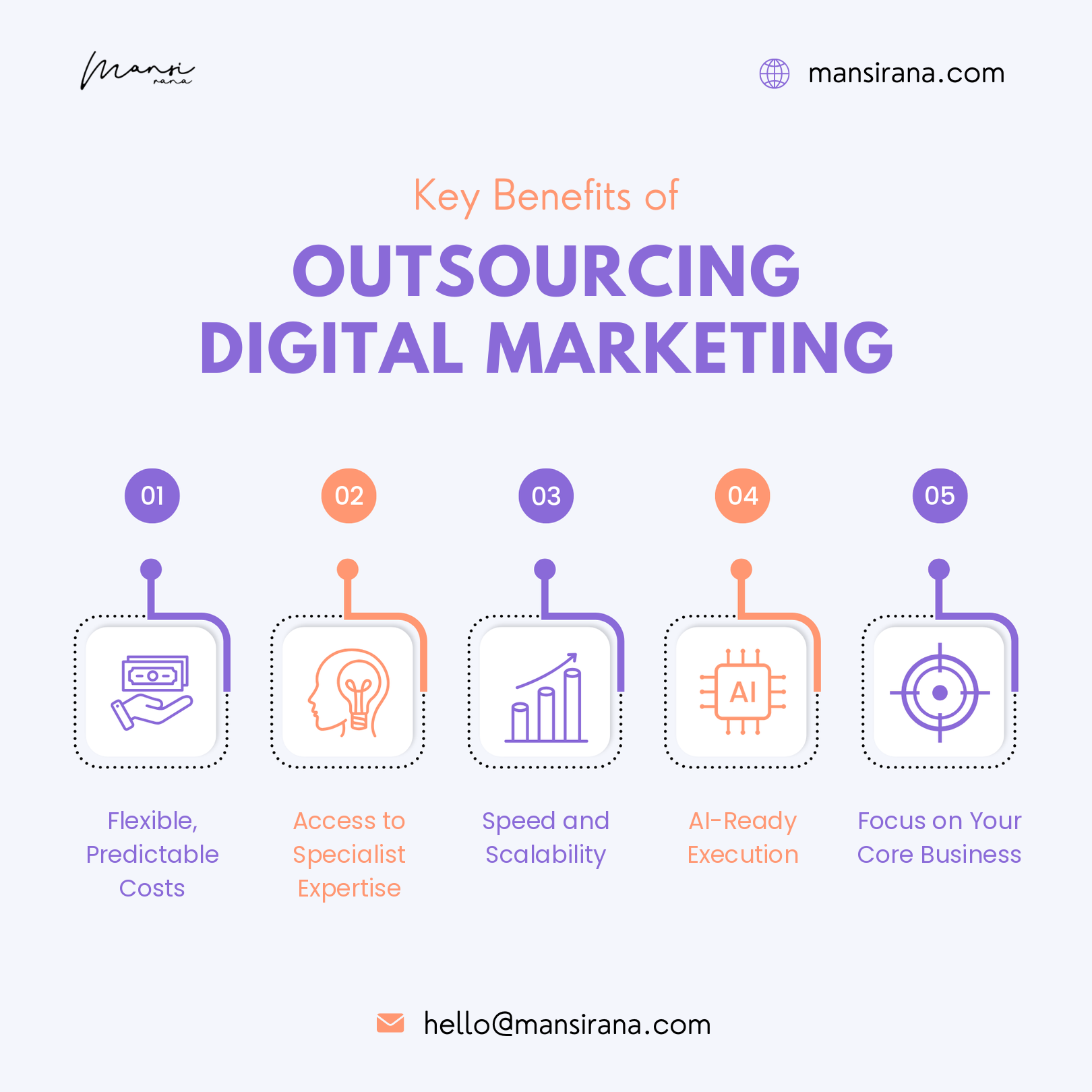
1. Flexible, Predictable Costs
Outsourcing swaps fixed overheads (salaries, recruitment, training, software licences) for a monthly fee tied to scope. You can scale spend up or down as priorities change. For a sense of real numbers, see the cost section below.
2. Access to Specialist Expertise
Agencies work across industries and see patterns a single in-house team never will. That experience, along with premium tools for SEO, analytics and automation, would be costly to build alone. It is the same reason we wrote about what managing 12,000+ marketing accounts teaches you that one brand cannot.
3. Speed and Scalability
A partner can launch a campaign in weeks rather than the months it takes to hire and train a team. When a product launch or seasonal peak demands more output, you add capacity instead of headcount.
4. AI-Ready Execution
Good partners already use AI for research, reporting, content workflows and personalisation, with human review where it matters. If you are curious how this works in practice, explore our guide to AI workflow automation services.
5. Focus on Your Core Business
When specialists handle the day-to-day of marketing, your leadership can focus on product, customers and operations. Small businesses in particular benefit from a focused plan, which our guide to digital marketing tips for small business lays out.
How Much Does It Cost to Outsource Digital Marketing in India?
Pricing varies widely with scope, seniority and competition. As a directional guide, Brainguru’s 2026 pricing breakdown puts typical Indian agency pricing in these ranges:
| Service |
Typical monthly cost in India (2026) |
| Overall digital marketing retainer |
Rs 25,000 to Rs 5,00,000+ |
| SEO |
Rs 15,000 to Rs 1,50,000 |
| Social media marketing |
Rs 15,000 to Rs 75,000 |
| Content marketing |
Rs 25,000 to Rs 1,00,000 |
| AI and marketing automation |
Rs 30,000 to Rs 2,00,000 |
Three things to keep in mind when you budget:
- Ad spend is separate. Budget the retainer, the media spend, tools and creative together, never the retainer alone.
- Add tax. Agency fees in India are normally billed with 18% GST, so a Rs 50,000 retainer becomes Rs 59,000 on the invoice.
- Treat all ranges as directional. No authoritative body publishes agency rate cards in India, as one 2026 pricing guide points out, so compare scope and seniority, not just price.
For global context, our own breakdown of fractional CMO versus agency costs shows mid-market agency retainers running roughly $2,500 to $12,000 a month, with PPC management typically priced at 10 to 20% of ad spend. Rising media costs are also changing the maths, as we discuss in why digital is getting expensive.
Types of Digital Marketing Services You Can Outsource
Search Engine Optimization (SEO) and AI Search Visibility
SEO still drives sustainable organic growth, but the job has widened. Buyers now find brands through AI assistants and generative search as well as classic results, so a modern engagement covers technical health, content quality and visibility inside AI answers. Read our guide to merging SEO, AEO and GEO and the five questions in still buying SEO the old way before you brief an agency. If you are comparing providers, our list of top SEO companies is a useful starting point.
Pay-Per-Click (PPC) and Performance Marketing
Paid media rewards constant optimisation: creative testing, audience refinement, bid strategy and budget allocation. A specialist keeps spend pointed at qualified buyers rather than cheap clicks. The most common problem is lead quality, not lead volume, which we address in improving PPC lead quality.
Content Marketing
Content builds trust and authority, and it feeds both search engines and AI answers. Outsourcing gives you consistent publishing across blogs, video, infographics and email without hiring a full editorial team. Make sure your partner understands quality signals such as Google’s E-E-A-T, so the content earns trust rather than just filling pages.
Social Media Management
Consistent posting, community engagement and reporting are time-consuming. An outsourced team keeps your profiles active and on-brand. For B2B brands, LinkedIn marketing deserves particular attention.
Email Marketing and Automation
Email remains one of the most controllable channels. A partner can segment your audience, write personalised sequences, manage deliverability and connect your CRM so follow-up happens automatically. Pairing it with AI-driven hyper-personalization takes this further.
Analytics, CRO and Funnel Optimisation
Traffic only matters if it converts. Outsourcing measurement and conversion work helps you see where prospects drop off and fix it, which often lifts results faster than increasing budget.
How to Choose the Right Digital Marketing Agency in India (or Offshore)
Choosing a partner is the single biggest decision in the whole process. Use this checklist:
- Relevant experience. Look for case studies in your industry with real numbers, not just logos.
- Senior involvement. Ask who will work on your account day to day and how much strategist time is included.
- Transparent reporting. You should see live dashboards and plain-language commentary, not vanity metrics.
- A clear AI position. Ask how they use AI, where humans review the output and how they protect your data when using AI tools.
- Data and account ownership. You should own ad accounts, analytics and content from day one, and the contract should say so.
- Honest expectations. Be wary of guaranteed rankings, vague deliverables and long lock-in contracts, particularly for a first engagement.
- Communication fit. Agree on time zones, meeting cadence and escalation paths up front.
If you are weighing an agency against a consultant, our guides on how to choose the right marketing consultant, hiring a digital marketing consultant in India and boutique digital marketing consulting explain the trade-offs. You can also compare options in our roundup of top digital marketing consultants.
Challenges in Outsourcing Digital Marketing

Loss of Control
An external team is not in your office, which can create distance. Fix it with a named point of contact, a shared scorecard and a fixed meeting rhythm.
Finding the Right Partner
Many agencies sound alike. Judge them on evidence: case studies, references and how clearly they explain their approach to your problem.
Integration With Your Team
Marketing, sales and product need to work from the same definitions of a lead and a customer. Align on those before the first campaign goes live.
Reporting That Hides Real Performance
Dashboards full of clicks and impressions can mask poor revenue results. If something feels off, a funnel audit will show where the leak is.
Data Privacy and Compliance
When an agency handles customer data, privacy is a shared responsibility. Global rules such as GDPR and CCPA still apply to many brands, and India now has its own regime. The Digital Personal Data Protection (DPDP) Rules were notified on 13 November 2025, with obligations phasing in over 18 months, and full compliance and penalties apply from May 2027. The same source notes that security failures alone can attract penalties of up to INR 250 crore.
In practice, that means:
- Put a data processing agreement in place with every marketing partner.
- Pre-approve who can access customer data and through which tools.
- Make sure consent records, deletion requests and breach reporting are covered.
- Agree what happens to your data when the contract ends.
This is general information, not legal advice. Involve your legal counsel when you draft the contract.
The Future of Outsourcing Digital Marketing
AI Agents Move From Experiment to Workflow
According to the Social Media Examiner report, 79% of marketers are either using AI agents or planning to. Expect outsourced teams to run more of the repetitive work (reporting, research, first drafts, bid adjustments) through agents, with people focused on strategy and quality control. If you want to see what this looks like beyond marketing, read our guide to AI automation consulting services.
Search Visibility Goes Beyond Google
Brands now need to be found and cited in AI assistants as well as ranked in search results. Agencies are building new skills here, and it is worth asking any prospective partner about their approach. We profile this shift in agencies for AI-driven search visibility.
Outcome-Based Contracts Gain Ground
Buyers want shared accountability. In the Mordor Intelligence outsourcing report, 68% of enterprises prefer shared-risk, shared-reward contracts tied to performance. Expect more retainers with performance components alongside fixed fees.
Hyper-Personalisation and Specialist Partners
Audiences expect experiences that reflect their needs, and AI makes that possible at scale. At the same time, more brands are choosing smaller specialist partners over large generalist agencies, for areas such as influencer marketing, conversion optimisation and AI search.
Best Practices for Outsourcing Digital Marketing
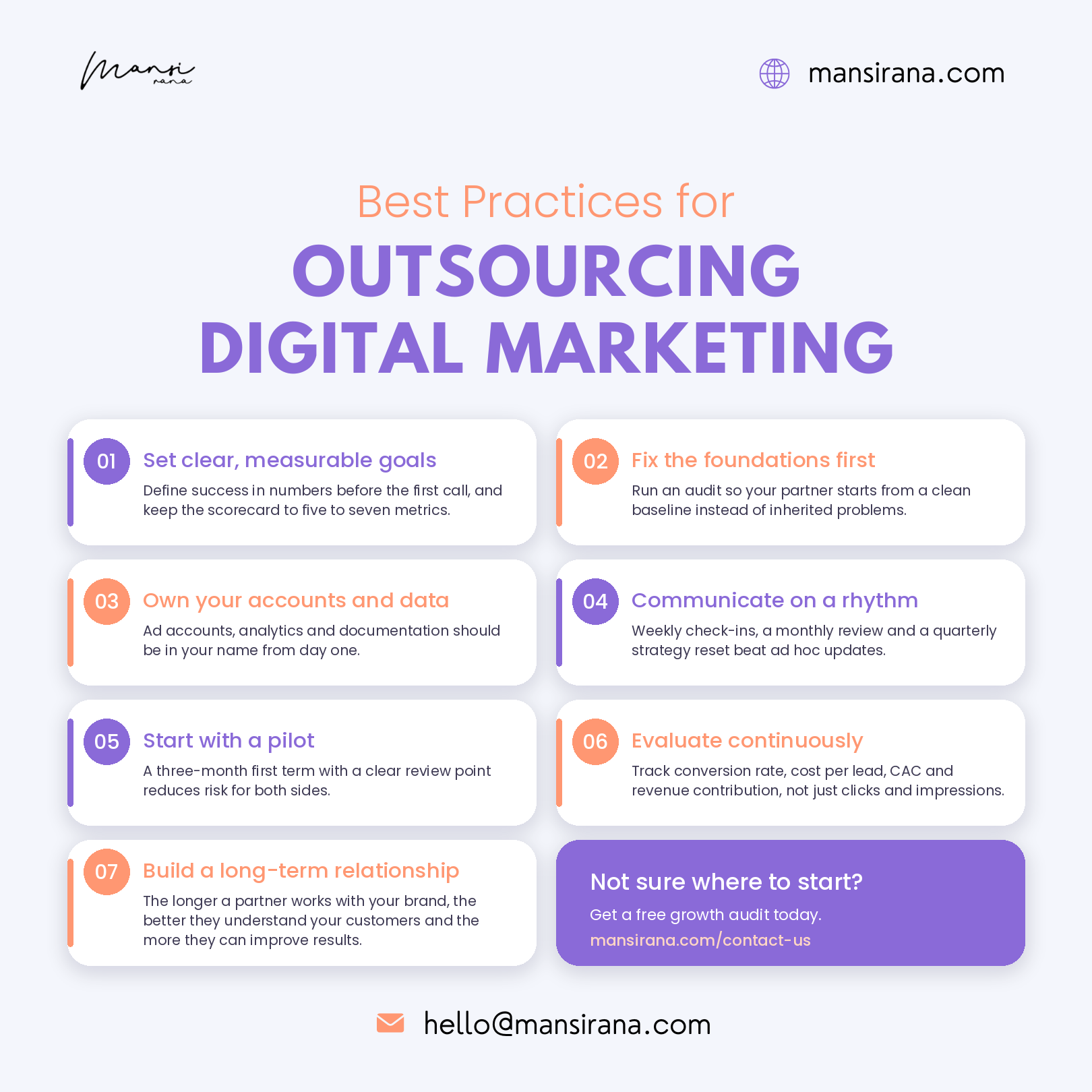
- Set clear, measurable goals. Define success in numbers before the first call, and keep the scorecard to five to seven metrics.
- Fix the foundations first. Run an audit so your partner starts from a clean baseline instead of inherited problems.
- Own your accounts and data. Ad accounts, analytics and documentation should be in your name from day one.
- Communicate on a rhythm. Weekly check-ins, a monthly review and a quarterly strategy reset beat ad hoc updates.
- Start with a pilot. A three-month first term with a clear review point reduces risk for both sides.
- Evaluate continuously. Track conversion rate, cost per lead, CAC and revenue contribution, not just clicks and impressions.
- Build a long-term relationship. The longer a partner works with your brand, the better they understand your customers and the more they can improve results.
Final Thoughts
Outsourcing digital marketing gives businesses of every size access to specialist skills, current tools and AI-ready workflows without the cost and delay of building a full in-house team. The model works best when you define your goals, choose a partner that fits your stage, protect your data and keep a steady rhythm of review.
If you want help deciding what to outsource and what to keep in-house, Mansi Rana Digital, a boutique digital marketing agency in India, works with founders and CMOs on growth consulting, audits and execution. Talk to Mansi Rana for a straight answer on the right setup for your business.
Frequently Asked Questions About Outsourcing Digital Marketing
What should I consider when choosing a digital marketing agency in India?
Look at industry experience, case studies with real results, who will actually work on your account, reporting transparency, AI capability, data protection practices and contract terms. Communication and proven results matter more than the lowest price.
What is the average cost of outsourcing digital marketing in India?
In 2026, agency retainers in India typically range from about Rs 25,000 to Rs 5,00,000+ per month depending on scope, seniority and competition. SEO usually sits between Rs 15,000 and Rs 1,50,000, and social media between Rs 15,000 and Rs 75,000. Ad spend and 18% GST are extra. See the cost table above for the full breakdown.
How long does it take to see results from outsourced digital marketing?
In our experience, paid campaigns show early improvement within 30 to 60 days, while SEO typically takes 90 to 120 days. Timelines depend on your starting point, competition and budget.
Can outsourcing digital marketing improve ROI for small and medium-sized businesses?
It can, when goals are clear and tracking is in place. Outsourcing gives smaller businesses access to specialist skills and tools they could not otherwise afford, and a good partner focuses spend on what converts. Results still depend on offer, pricing and sales follow-up, so measure revenue, not just activity.
How do I ensure quality and consistency when outsourcing?
Set expectations in writing, agree on one shared scorecard, hold regular check-ins and insist on transparent reporting. Review samples of work early, and make sure brand guidelines and approval steps are documented.
Is it safe to share customer data with a marketing agency?
It can be, with the right safeguards. Use a data processing agreement, limit access to what the work needs, make sure the agency follows India’s DPDP Rules and any other applicable laws, and agree on how data is returned or deleted at the end of the contract.